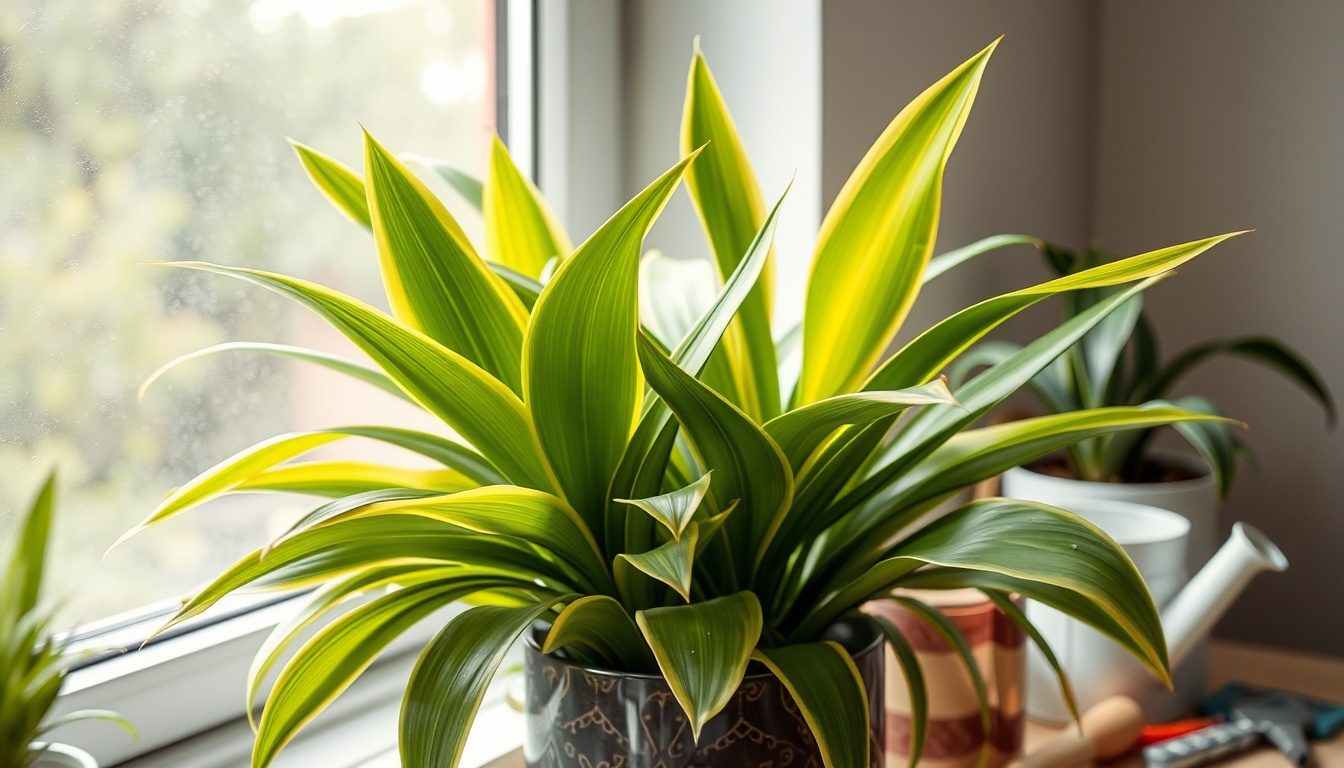
You know that plant on your coworker’s desk that never seems to need anything yet keeps pushing out fresh green leaves? That’s the Happy Plant, an unofficial mascot of low-effort greenery that forgives forgetful watering and delivers a consistent green payoff.
Botanical name: Dracaena fragrans ·
Common name: Happy Plant, Corn Plant ·
Native range: Tropical Africa ·
Maximum indoor height: 6 feet (1.8 m) ·
Light requirement: Bright indirect ·
Water frequency: Every 1–2 weeks, allow top inch to dry
Quick snapshot
- Scientific name: Dracaena fragrans (Royal Horticultural Society (UK’s leading gardening charity))
- Prefers bright indirect light, not direct sun (New York Botanical Garden (premier botanical research institution))
- Overwatering causes root rot (University of Florida IFAS Extension (agricultural research authority))
- Air‑purifying: removes formaldehyde, benzene, trichloroethylene (NASA Clean Air Study (Tier 1 research))
- Exact watering frequency varies by season and home humidity – White Flower Farm recommends top 1 in. in spring/summer, 2 in. in fall/winter (White Flower Farm (specialist nursery))
- Optimal watering schedule also depends on soil – allow top 2 in. to dry before watering (ScottsMiracle‑Gro (global lawn and garden brand))
- Whether misting is beneficial or harmful long‑term remains debated (Wild Interiors (indoor plant retailer))
- Brown leaf tips signal dry air or low humidity (Yates Australia (gardening brand with local expertise))
- Yellow leaves signal overwatering (Deep Green Permaculture (sustainable gardening resource))
- Fertilize monthly during spring and summer with half‑strength liquid fertilizer (ASPCA (American animal poison control authority))
- Repot every 2–3 years or when roots crowd the pot (ScottsMiracle‑Gro (global lawn and garden brand))
A quick glance at six essential specs reveals one pattern: the Happy Plant asks for very little but delivers consistent green payoff.
| Label | Value | Source |
|---|---|---|
| Botanical name | Dracaena fragrans | RHS |
| Common names | Happy plant, Corn plant, Mass cane | White Flower Farm (specialist nursery) |
| Origin | Tropical Africa | RHS |
| USDA hardiness zones | 10–12 (outdoors) | NYBG |
| Toxicity | Mildly toxic to pets (dogs, cats) – contains saponins | ASPCA |
| Air‑purifying | Removes formaldehyde, benzene, trichloroethylene | NASA Clean Air Study |
How do you take care of a happy plant?
What is the real name of a happy plant?
- Botanically Dracaena fragrans, also called corn plant because its leaves resemble corn stalks (RHS).
- Sometimes listed as Dracaena massangeana (a cultivar) (White Flower Farm).
The retail name “Happy Plant” is marketing shorthand, but the botanical identity is consistent. That clarity matters when you search for care advice: any guide for Dracaena fragrans applies directly.
How to grow a happy plant from a cutting?
Propagation is straightforward, though success rates vary. Here’s a step-by-step method using stem cuttings, the most reliable approach.
- Cut a healthy stem section at least 6 inches long with several leaf nodes.
- Remove lower leaves and place the cutting in a glass of filtered or rainwater (tap water may cause tip browning due to fluoride).
- Change the water weekly and keep in bright indirect light. Roots typically appear within 3–6 weeks.
- Once roots are 1–2 inches long, pot in a well-draining mix with perlite or vermiculite (White Flower Farm).
- Water sparingly for the first month to avoid rot while the cutting establishes.
Stem propagation gives you a new Happy Plant for free, but patience is key. The cutting will look stagnant for weeks before roots emerge — that’s normal growth rhythm, not failure.
The implication for first-timers: don’t be discouraged by the waiting period. Once roots appear, the young plant establishes quickly.
Where is the best place to put a happy plant?
Is a happy plant suitable for indoors?
- Highly suitable: it’s one of the most forgiving indoor foliage plants (RHS).
- Thrives in indirect light levels typical of living rooms and offices (NYBG).
Can a happy plant survive in a bedroom?
- Yes, as long as there’s a window providing bright indirect light. Avoid placing it in a dark corner with no natural light.
- Keep away from drafts and heating vents to prevent temperature stress (NYBG).
Two key restrictions, one core preference: keep it away from direct sunlight (which burns leaves) and away from cold drafts or heat registers. Inside that envelope, the Happy Plant adapts to nearly any room.
For urban apartment dwellers with north-facing windows, the Happy Plant is one of the few houseplants that won’t sulk. It trades speed of growth for resilience — slow but steady.
What this means: you don’t need a sun‑drenched conservatory to succeed with this plant. A typical living room is enough.
Do happy plants need a lot of light?
- Thrives in bright, indirect light — an east-facing window or a spot a few feet back from a south/west window (White Flower Farm).
- Can survive in low light, but growth will slow significantly (NYBG).
- Leaves may become pale or elongated if light is too weak (Wild Interiors).
- Rotate the plant monthly for even leaf development (ScottsMiracle‑Gro).
The trade‑off: the Happy Plant won’t die in a dim corner, but it will also stop looking happy. If you want lush, bushy growth, give it real light — not a desk lamp.
How big does a happy plant grow?
What factors influence the height of a happy plant?
- Indoors: typically 4–6 feet tall, but can be kept shorter by pruning (RHS).
- Outdoors in tropical zones: can reach 15 feet (White Flower Farm).
- Growth rate: slow to moderate — expect a few inches per year under good conditions.
- Pruning the top stem encourages branching and keeps height manageable.
The pattern: the Happy Plant is a long-term investment. It doesn’t shoot up overnight, but a well-cared-for specimen can become a room-dividing presence over years.
What are common happy plant problems?
Why are my happy plant leaves turning yellow?
- Most common cause: overwatering leading to root rot (RHS).
- Other possibilities: fluoride toxicity from tap water (RHS), insufficient light, or nutrient deficiency.
Yellowing bottom leaves are part of the natural aging process. If upper leaves yellow, check the soil moisture first — it’s likely too wet.
How to treat brown tips on a happy plant?
- Brown, crispy tips often indicate low humidity or underwatering (NYBG).
- Also linked to fluoride in tap water — use filtered or rainwater if possible (RHS).
- Increase humidity with a pebble tray or occasional misting (NYBG).
- Trim the brown tips with clean scissors — the leaf won’t regrow green, but the plant will be healthier.
Brown tips can be caused by dry air, fluoride, underwatering, or even fertilizer salt buildup. You may need to adjust multiple factors before you see improvement.
The implication: diagnosing the exact cause requires eliminating possibilities one by one. Start with the simplest — increase humidity.
What we know vs. what remains unclear
Confirmed facts
- Scientific name is Dracaena fragrans (RHS)
- Bright indirect light required (NYBG)
- Overwatering causes root rot (University of Florida IFAS Extension)
What remains unclear
- Exact watering frequency differs by source – RHS says top 2 in.; White Flower Farm says top 1 in. in summer
- Optimal humidity for fastest growth is not experimentally determined
- Effect of different light spectra on leaf variegation remains anecdotal
- Whether misting is beneficial or harmful long‑term
Expert perspectives
“Dracaena fragrans is a hardy and easy to care for plant, ideal for beginners.”
“Also called the corn plant, Dracaena fragrans is one of the most popular indoor foliage plants because it tolerates low light and neglect.”
“Allow the soil to dry between waterings to prevent root rot — dracaena dislike soggy feet.”
— University of Florida IFAS Extension (agricultural research authority)
The catch: these three perspectives agree on the plant’s forgiving nature, but each emphasizes a different aspect — beginner‑friendliness, low‑light tolerance, and watering discipline.
Bottom line: The Happy Plant is what its reputation says — an undemanding indoor companion that survives low light and irregular watering. For busy professionals, it offers greenery without guilt. For plant enthusiasts, it rewards attention with steady growth and the possibility of propagation. The implication for first-time owners: ignore the hype about fancy care routines. Stick to the basics — moderate light, sparse water, no direct sun — and your Happy Plant will live up to its name.
For those interested in a more detailed care guide for Dracaena fragrans, detailed care guide for Dracaena fragrans offers additional insights into its characteristics and maintenance.
Frequently asked questions
Is a happy plant toxic to cats and dogs?
Yes, mildly toxic. Dracaena fragrans contains saponins that can cause drooling, vomiting, and loss of appetite in pets (ASPCA). Keep out of reach of curious animals.
How often should I fertilize a happy plant?
Fertilize monthly during spring and summer with a balanced liquid fertilizer diluted to half strength (White Flower Farm). Stop fertilizing in fall and winter.
Can I propagate a happy plant in water?
Yes. Place a stem cutting in a jar of filtered or rainwater, change the water weekly, and roots should appear in 3–6 weeks (RHS).
Why does my happy plant have sticky leaves?
Sticky leaves usually indicate a pest infestation, most commonly scale insects or mealybugs (Wild Interiors). Wipe leaves with a damp cloth and treat with insecticidal soap.
Should I mist my happy plant?
Misting can help raise humidity temporarily, but it’s not essential (NYBG). A pebble tray or grouping with other plants is more effective for long-term humidity.
How do I prune a happy plant?
Cut the top of the stem at any height using clean, sharp pruners. The stem will produce two new shoots below the cut, making the plant bushier (ScottsMiracle‑Gro).
Can a happy plant grow in a bathroom?
Yes, if the bathroom has a window providing bright indirect light. The extra humidity is actually beneficial (RHS).
Knowing these answers helps you avoid common mistakes and keep your Happy Plant thriving for years.
Related reading
Related stories


Sophie Campbell covers business, markets and economic policy for Australia Voice.