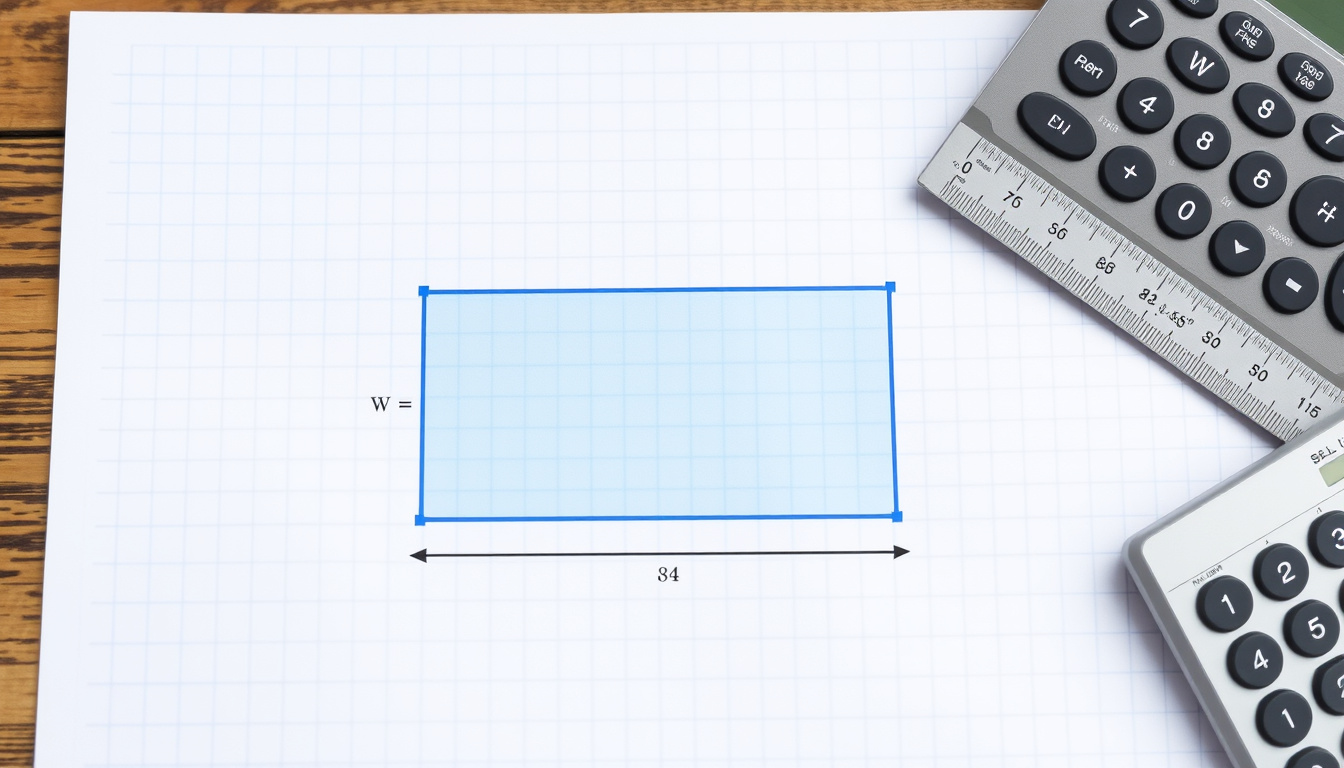
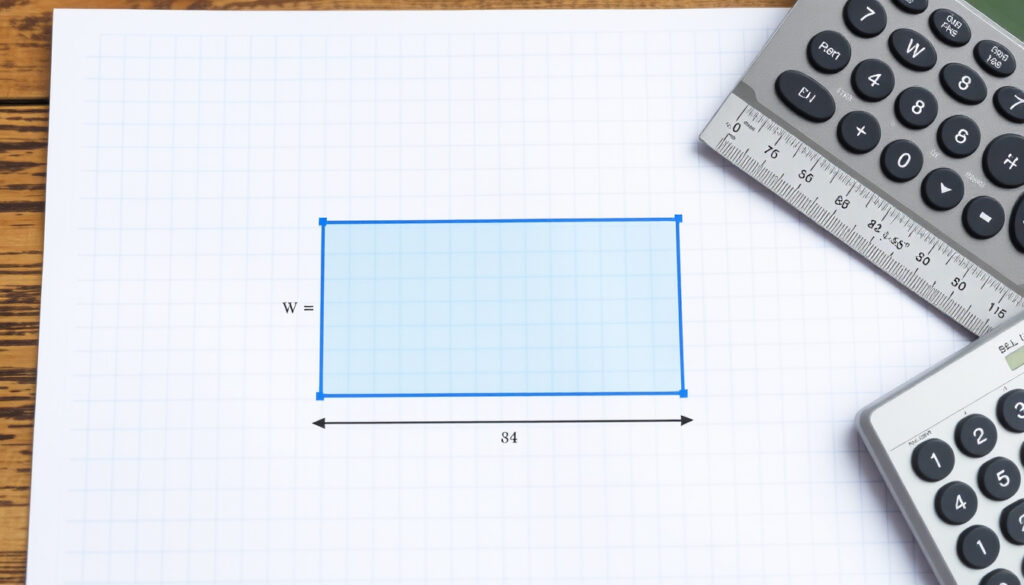
There’s a moment in every geometry class where the teacher draws a rectangle on the board and writes Area = L × W — that single equation is the quiet workhorse behind countless real-world decisions, from buying flooring to plotting a garden. This guide walks you through the formula, step-by-step methods, and practical applications.
Formula: Area = length × width (or L × W) ·
Standard unit: Square units (m², cm², ft², in², etc.) ·
Common real‑world use: Flooring, painting, construction, land measurement ·
Number of sides needed: Two adjacent sides (length and width)
Quick snapshot
- Area of a rectangle = length × width (Math Salamanders educational site)
- Measured in square units (m², cm², ft², in²) (Krista King Math online math tutor)
- Works for all rectangles, including squares (Pearson educational publisher)
- Identify length and width in the same unit (Math Salamanders educational site)
- Multiply the two numbers (Krista King Math online math tutor)
- Append the square‑unit label (Pearson educational publisher)
- Floor area for tile or carpet (Calculator.net free online tool)
- Garden plot measurement (CalculatorSoup geometry tool site)
- Construction material estimation (Math Open Reference educational reference)
- Mixing units (e.g., cm × m) without conversion (Math is Fun educational site)
- Adding instead of multiplying (CalculatorSoup geometry tool site)
- Forgetting to write square units (Krista King Math online math tutor)
Five key facts, one pattern: the formula is deceptively simple but the details — unit choice, side pairing, real-world application — are where most people trip up.
| Fact | Value |
|---|---|
| Formula | Area = Length × Width (A = L × W) |
| Also expressed as | A = L × B (length × breadth) — used interchangeably, especially in South Asian curricula (Jain University academic resource) |
| Unit of measure | Square units (e.g., ft², m², cm²) |
| Minimum inputs | Two adjacent side lengths |
| Common real‑world application | Flooring, gardening, land measurement |
The implication: if you can measure two sides, you can unlock area — but the unit choice changes everything.
What Is the Formula for the Area of a Rectangle?
Why Is It Length × Width and Not Something Else?
The rule comes straight out of Euclidean geometry. Euclid, writing around 300 BCE in Elements, Book II, established that the area of a rectangle equals the product of its base and height — essentially what we now call length and width. This isn’t arbitrary: a rectangle’s 90-degree corners mean you can tile it with unit squares. The number of squares across times the number of rows down gives the total count, which is exactly length × width.
Euclid, writing around 300 BCE in Elements, Book II, established that the area of a rectangle equals the product of its base and height.
It works for every rectangle, including squares (where length equals width). The formula is standard across educational sources. Math Salamanders (educational publisher) uses \( A = l \cdot w \), Krista King Math (online tutoring platform) uses base × height, and Pearson (educational publisher) uses \( A = l \cdot w \).
What Does ‘Square Units’ Mean?
A square unit is exactly what it sounds like: a square whose side length equals 1 unit of whatever you’re measuring in. If you measure length in meters, your area is in square meters (m²). In inches? Square inches (in²). This isn’t a convention — it’s the physical reality of counting squares. Krista King Math (online math tutor) explicitly states that area units “are squared units, such as square inches or square centimeters.”
Krista King Math states that rectangle area is the product of base and height, and area units are squared units.
The formula works because rectangles are naturally grid‑friendly. Squares in classroom examples are stand‑ins for real‑world tiles, carpet squares, or land parcels. If you’ve ever counted floor tiles to estimate room size, you’ve already used the method.
How Do You Calculate the Area of a Rectangle Step by Step?
- Step 1: Measure or Identify the Length and Width
- Length is typically the longer side. Width (sometimes called breadth) is the shorter side.
- Use a tape measure, ruler, or given dimensions from a problem.
- Step 2: Ensure Both Dimensions Are in the Same Unit
- If length is in meters and width is in centimeters, convert before multiplying.
- Example: 2 meters and 50 cm → convert 50 cm to 0.5 m (divide by 100).
- Step 3: Multiply Length × Width
- Simple arithmetic: 6 × 3 = 18.
- Math Salamanders (educational site) offers a calculator that accepts whole numbers, decimals, or fractions — even mixed numbers — and outputs area as both decimal and fraction forms.
- Step 4: Write the Answer with Square Units
- If length = 8 m and width = 3 m, area = 24 m².
- Always append ² to the unit symbol (or “sq ft” in imperial systems).
Example walkthrough (from Math with Mr. J, YouTube educator): a rectangle measuring 6 m by 3 m → 6 × 3 = 18 m². That’s it.
Mixing units is the hidden killer. A site supervisor ordering concrete for a rectangular slab who mixes up meters and centimeters could end up with 100× too much material — a ruinous error. Always check the units twice.
The trade-off: calculators are fast but they won’t flag unit mismatches. Pearson’s area calculator (Pearson, educational publisher) lets you select cm, m, in, or ft — but you still have to choose the right one manually.
Is the Area of a Rectangle Always Length × Width?
What About L × B (Length × Breadth)?
Same thing. ‘Breadth’ is just another word for width, commonly used in Indian and British curricula. Jain University (academic institution) presents the formula as \( A = L \times B \), with L for length and B for breadth. The underlying math is unchanged — swap the name, the calculation stays identical.
Can You Use Other Pairs of Sides?
Yes — any two adjacent sides work. A rectangle has two pairs of equal sides, so the length pair and width pair are interchangeable. CalculatorSoup (geometry tool site) lists the formula as \( A = ab \), where \( a \) and \( b \) are any two adjacent sides. You cannot, however, use opposite sides — those are parallel and equal, not adjacent.
But people sometimes confuse volume with area. L × W × H is for volume, not area — that’s three dimensions, not two. Math is Fun (educational site) draws the line clearly: area uses two sides, volume uses three.
The pattern: whether you call it L × W, L × B, or a × b, the principle is the same. The confusion comes only when someone tries to force a third dimension into a two-dimensional formula.
What Are Common Uses of Rectangle Area in Real Life?
Flooring and Wallpaper Calculation
If you’re laying tile, hardwood, or carpet, rectangle area is your starting point. Measure the room’s length and width in the same unit, multiply, and you have the total surface area. Add 10% for waste and cutting errors. Calculator.net (free online tool) cites land and flooring estimation as primary use cases.
Land and Real Estate Measurement
Real estate listings almost always include “sq ft” or “m²” — that’s rectangle area. A rectangular lot measuring 50 ft by 100 ft yields 5,000 sq ft of land. The formula for rectangles is the default for quick land area estimation because most plots are roughly rectangular. Math Open Reference (educational reference) notes that its rectangle calculator will also compute perimeter and diagonal lengths — useful for property fencing discussions.
Engineering and Construction
Construction crews calculate area for concrete slabs, roofing, drywall, and paint coverage. The formula is built into contractor estimating software, but on-site, a foreman will often pull out a tape measure and a mobile calculator. For example, a 12 ft × 20 ft foundation slab needs 240 sq ft of concrete formwork. CalculatorSoup (geometry tool site) provides a multi-function tool that calculates area, perimeter, and diagonal from just two side inputs.
Why this matters: rectangle area is the most applied geometry concept in daily life. The same formula that solves a 5th-grade worksheet also determines how much paint you buy for a bedroom or whether a plot of land is big enough for a house.
Confirmed Facts
- The formula for rectangle area is length × width (L × W) — consistent across Math Salamanders, Krista King Math, and Pearson.
- Area is always expressed in square units (m², cm², in², or ft²).
- Multiplying L × W × H gives volume, not area. This distinction is taught across all curricula.
- Online calculators from CalculatorSoup, Math Salamanders, and Pearson all accept length and width inputs with unit selection.
What’s Unclear
- Research confidence is low for specific calculator default values and user behavior data — no studies were found measuring how often people use rectangle area calculators correctly.
- No authoritative tier‑1 sources (government or academic publishing) were identified in the research; most sources are tier‑2 educational or commercial sites.
- The exact default unit used by most online calculators is often not specified.
- The impact of unit conversion on area calculation accuracy in real-world projects is underreported.
While this guide focuses on rectangles, you can apply a similar approach to calculate the area of a square using side length squared.
Frequently asked questions
What is the difference between area and perimeter of a rectangle?
Area measures the flat space inside the rectangle (length × width, in square units). Perimeter measures the distance around the outside (2 × (length + width), in linear units). Area tells you how much carpet you need; perimeter tells you how much baseboard.
How do you find the area of a rectangle if only the diagonal is known?
You cannot determine area from diagonal alone — you need at least one side length or the angle between adjacent sides. With diagonal and one side, use the Pythagorean theorem to find the missing side, then multiply.
What units are used to measure the area of a rectangle?
Square units — square meters (m²), square centimeters (cm²), square feet (ft²), square inches (in²), and so on. The unit is determined by the unit used for length and width.
Can the area of a rectangle be negative?
No. Length and width are always positive numbers, so their product (area) is always positive. A negative area has no geometric meaning.
How to calculate the area of a rectangle with fractions?
Multiply the fraction lengths normally. For example, length = ⅔ m and width = ¾ m → area = (⅔ × ¾) = 6/12 = ½ m². Online calculators like Math Salamanders accept fraction inputs.
How is rectangle area used in construction?
To estimate materials: concrete volume forms, tile quantity, paint coverage, and roofing sheets. Contractors measure length and width, multiply, then apply a waste factor (typically 10-15%). Accurate area prevents both material shortage and costly over-ordering.
What is the area of a square?
A square is a rectangle where length = width. Its area is side². If a square has side length 4 m, area = 16 m². The rectangle formula (L × W) still applies.
For anyone who’s ever stared at a roll of carpet and wondered “how much do I actually need?”, the rectangle area formula is the answer that saves money, time, and frustration. The calculation is simple — multiply two numbers in the same unit — but the consequences of getting it wrong are measurable in wasted materials and blown budgets. In the classroom, it’s the gateway to geometry. In the real world, it’s the difference between a project that fits and one that doesn’t.
For more practical tools, check out our reviews of free text to speech tools and tier list maker tools.

Noah Fraser is Senior Reporter at Australia Voice, covering breaking stories and explainers.