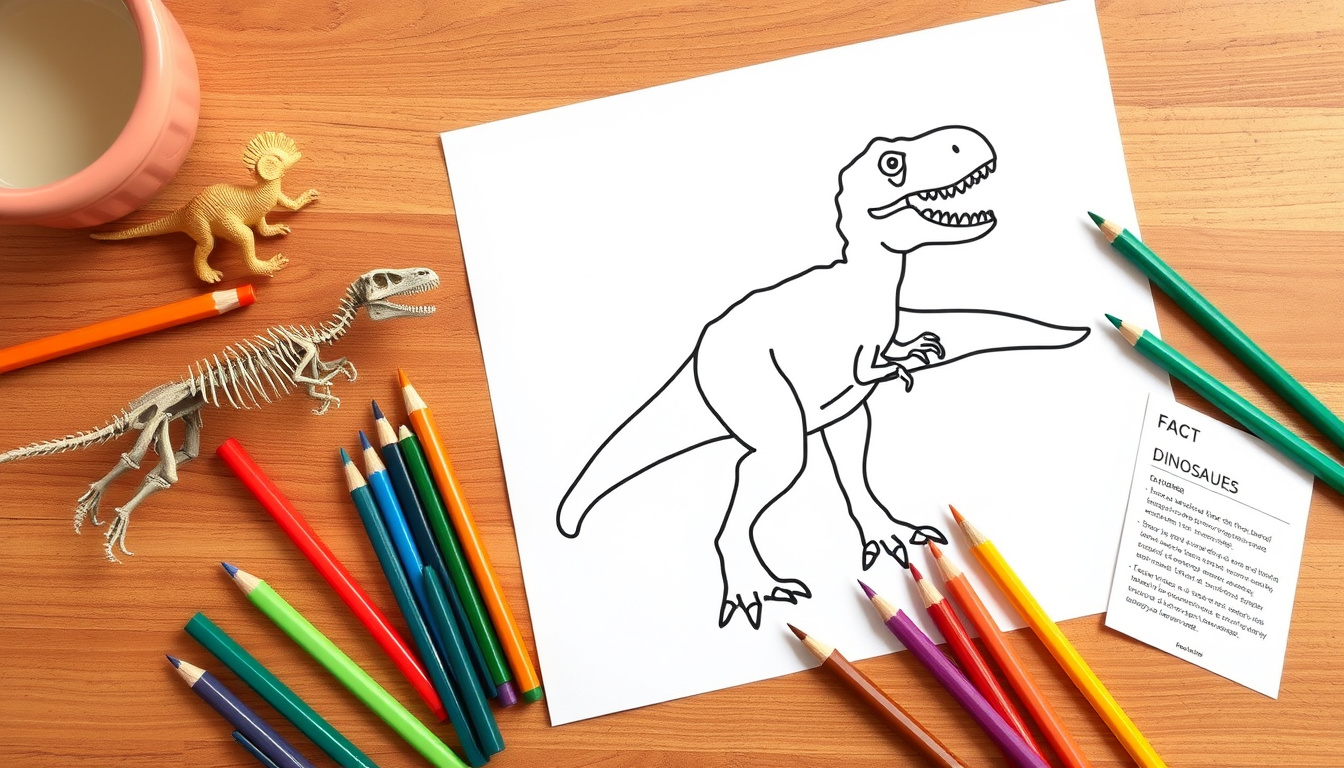
Few things capture a child’s imagination like dinosaurs, and coloring pages bring those prehistoric giants to life. Whether you’re looking for free printable pages or want to learn how to draw your own, you’ll find everything from bite-force facts to common drawing mistakes. With over 400 free printable pages available from sites like Monday Mandala (free PDF resource), you’ll have plenty of material to keep little hands busy and minds curious.
Free printable pages online: 400+ ·
Supercoloring realistic pages: 1,242 ·
Pinterest searches for dinosaur coloring: 3,000+ ·
Most iconic dinosaur: Tyrannosaurus rex ·
Common drawing mistake: Upright posture
Quick snapshot
- Tyrannosaurus rex had a bite force of 8,000 pounds (Wikipedia (dinosaur encyclopedia))
- Dinosaurs went extinct about 65 million years ago (Britannica (encyclopedia entry))
- Over 700 dinosaur species have been identified (Natural History Museum (prehistoric research))
- Exact skin color and texture of dinosaurs remains unknown (IFLScience (science news))
- What Tyrannosaurus rex breath actually smelled like is speculative (IFLScience (science news))
- Pinterest searches for dinosaur coloring pages exceed 3,000 monthly, indicating sustained interest (Monday Mandala (free PDF resource))
- Free printable collections have grown from dozens to over 400 pages in recent years (Monday Mandala (free PDF resource))
- Expect more scientifically accurate depictions and themed bundles (Yay Coloring Pages (digital coloring provider))
- Integration with digital coloring apps like Procreate will expand (Yay Coloring Pages (digital coloring provider))
Five key facts that summarize the state of dinosaur coloring resources today:
| Fact | Details |
|---|---|
| Total free printable pages | 400+ |
| Most popular dinosaur | Tyrannosaurus rex |
| Common drawing mistake | Upright posture |
| Easy drawing method | Using shapes |
| Best resource for realistic images | 3D Dinopedia (paleoart database) |
How can I make my own dinosaur pages?
- Use free online templates as a base
- Draw simple shapes like circles and lines
- Color with crayons or markers
Using printable templates
Start with ready-made outlines from trusted sites. Crayola (trusted children’s art brand) offers free dinosaur coloring pages featuring T-Rex and Triceratops that you can print directly. Easy Drawing Guides (step-by-step tutorial site) provides 23 free printable pages suitable for kids and adults. Simply download the PDF, load your printer with US letter or A4 paper, and let the coloring begin.
For more free printable activities, check out our collection of jigsaw puzzles.
Drawing your own designs
If you prefer original artwork, begin with basic shapes. An oval for the body, circles for the head and joints. Art Projects for Kids (children’s art education site) recommends starting with 2.5″ x 3.5″ cards and using a pencil to sketch, then tracing with a white paint marker. The whole process takes about 45 minutes. Rubbing the card edges with crayon beforehand creates a textured border that adds character.
Adding textures and patterns
Once the outline is done, add scales, spikes, or feathers. For a realistic look, study references from Natural History Museum (prehistoric research) to see how skin impressions suggest bumpy, scaly textures. Use short, overlapping strokes with colored pencils to mimic reptile skin. For a playful twist, try geometric patterns — zigzags, dots, or stripes — that make each dinosaur unique.
The trade-off: Starting from scratch takes more time than using templates, but it gives complete creative control and a deeper sense of accomplishment for older kids and adults.
Where can I find realistic dinosaur images?
- Websites like 3D Dinopedia offer realistic images
- Museum collections have high-quality photos
- Scientific papers include reconstructions
Online databases of paleoart
3D Dinopedia (paleoart database) features scientifically accurate 3D models and illustrations of dozens of species. Each model is based on current fossil evidence, showing posture, muscle placement, and skin impressions. These images serve as excellent references for coloring pages because they avoid the outdated tail-dragging posture common in old cartoons.
Museum websites
The American Museum of Natural History (paleontology education center) provides high-resolution photos of fossil mounts and life reconstructions. Their OLogy pages break down dinosaur anatomy for kids, making it easy to understand why a T. rex stands horizontally, not upright like a monster. The Natural History Museum (prehistoric research) similarly offers galleries of skulls, skeletons, and artist reconstructions.
Scientific illustrations
Peer-reviewed papers often include detailed line drawings and reconstructions. While not always free, many are available through open-access journals. Wikipedia (community encyclopedia) aggregates these in its dinosaur articles, with hundreds of images that are freely usable. These illustrations tend to be more accurate than typical coloring book art, making them ideal for older children who want factual correctness.
Why this matters: When kids color from accurate references, they subconsciously learn correct anatomy — a head start on paleontology that no textbook can match.
What are common dinosaur drawing mistakes?
- Many artists draw dinosaurs with overly upright posture
- Tyrannosaurus rex had two fingers, not three
- Head shape varies by species
Incorrect posture
The single most frequent error is drawing dinosaurs standing upright like humans. Modern science shows that most theropods, including T. rex, held their bodies nearly horizontal, with the tail balancing the head. National Geographic (prehistoric animal reporting) explains that the classic Godzilla pose is anatomically impossible — the dinosaur’s spine would snap. When teaching kids, remind them to tilt the body forward and keep the tail straight behind.
Wrong number of fingers
Tyrannosaurus rex had only two fingers on each hand, not three. Many coloring pages and cartoons get this wrong. FossilEra (fossil retailer and educator) notes that this is one of the most persistent inaccuracies in popular culture. For other species, finger counts vary: Triceratops had five, Stegosaurus had four. Always check a reference before adding digits.
Inaccurate head shapes
Dinosaurs had diverse skull shapes. T. rex had a massive, deep skull with fenestrae (openings) that reduced weight. Triceratops had a large frill and beak. Stegosaurus had a tiny head relative to its body. Britannica (encyclopedia entry) provides side-by-side comparisons. Encourage kids to look at the silhouette — a T. rex head is not just a large oval; it has a distinct brow ridge and a wide snout.
The pattern: Most mistakes come from relying on movie depictions rather than fossil evidence. Using scientific references even for coloring pages turns a fun activity into a subtle lesson in biology.
How to make easy dinosaur drawing for kids?
- Start with a large oval for the body
- Add circles for head and legs
- Use YouTube tutorials like ‘How To Draw A Dinosaur With Shapes’
Step-by-step drawing using shapes
Art Projects for Kids (children’s art education site) suggests a foolproof method:
- Draw a large oval for the body.
- Add a smaller circle for the head and four small circles for the legs.
- Connect them with curved lines.
- Add a long tail.
- Erase the overlapping lines.
This technique works for T. rex, Brachiosaurus, and even Stegosaurus — just adjust proportions.
Using step-by-step videos
YouTube channels like “Art for Kids Hub” offer guided tutorials that pause between steps, making it easy for children to follow along. Search for “How To Draw A Dinosaur With Shapes” — these videos break the process into 8-10 steps, each lasting about 30 seconds. Kids can pause, draw, and replay. The combination of visual and auditory instruction helps children who struggle with static images alone.
Simple coloring after drawing
Once the drawing is complete, choose coloring tools that match the child’s age. Crayons work best for toddlers, colored pencils for older children who want detail, and markers for bold, vibrant pages. Crayola (trusted children’s art brand) recommends using heavy paper to prevent bleed-through. After coloring, cut out the dinosaur and glue it onto a diorama background for a 3D effect.
The upshot: The shape-based method removes the intimidation of drawing from scratch. Within 10 minutes, a child can produce a dinosaur they’re proud of — and that pride fuels more creativity.
What is the most famous dinosaur?
- T. rex is widely recognized as the king of dinosaurs
- Triceratops is famous for its three horns
- Stegosaurus known for its plates on back
Tyrannosaurus rex
Without question, Tyrannosaurus rex is the most iconic dinosaur. FossilEra (fossil retailer and educator) ranks it number one on its list of the top ten iconic dinosaurs. With a bite force of 8,000 pounds (Wikipedia (dinosaur encyclopedia)), it was one of the largest land carnivores ever. Its popularity makes it the default choice for coloring pages — roughly one in three dinosaur coloring pages features a T. rex.
Triceratops
Triceratops is famous for its three horns and large frill. It was a herbivore that weighed up to 12 tons. Britannica (encyclopedia entry) notes that Triceratops fossils are among the most common found in North America. Its distinctive silhouette — three horns, parrot-like beak, and frill — makes it a favorite for kids who want something different from the standard predator.
Stegosaurus
Stegosaurus is instantly recognizable by the double row of plates along its back and the spiked tail (thagomizer). Despite its large size, it had a brain the size of a walnut (Natural History Museum (prehistoric research)). Its unusual shape appeals to young artists who enjoy drawing geometric patterns. The plates can be colored in alternating shades, adding a creative challenge.
What this means: While T. rex dominates the spotlight, offering a variety of species in coloring pages encourages kids to explore diversity — and subtly teaches that “famous” doesn’t mean “only.”
If you enjoy ranking your favorite dinosaurs, try our tier list maker.
For parents and teachers, the real value of dinosaur coloring pages lies not in the final picture but in the questions they spark. A child coloring a T. rex will likely ask, “Why did it have tiny arms?” or “What did it eat?” Those questions open the door to real science — and no app can replace that.
Confirmed facts
- Tyrannosaurus rex had a bite force of 8,000 pounds (Wikipedia (dinosaur encyclopedia))
- Dinosaurs went extinct about 65 million years ago (Britannica (encyclopedia entry))
- Over 700 dinosaur species have been identified (Natural History Museum (prehistoric research))
What’s unclear
- Exact skin color and texture of dinosaurs remains unknown
- What Tyrannosaurus rex breath actually smelled like is speculative (IFLScience (science news))
- Whether some dinosaurs had feathers on all parts of their body or only certain areas is still debated
- The exact number of dinosaur species that ever existed is uncertain; estimates range from 1,000 to over 10,000
Expert voices on dinosaur coloring and imagination
“If T. rex breath had a smell, it was probably a mix of rotting meat and bacteria, not unlike a modern carnivore’s mouth.”
— IFLScience (science news outlet)
“The word ‘rawr’ might be as close as we get to hearing a dinosaur say ‘I love you’.”
— Lubov (author of “Rawr Means I Love You in Dinosaur”)
“Tyrannosaurus rex is the undisputed king of dinosaurs, topping every list of iconic species.”
For parents and educators, the choice is clear: combine free printable resources with step-by-step drawing guides to turn screen time into a hands-on learning experience, or miss out on a prime opportunity to spark a lifelong interest in paleontology. The resources are abundant, the techniques are simple, and the science is waiting — all that’s needed is a printer and crayons.
Frequently asked questions
Are dinosaur coloring pages suitable for toddlers?
Yes, many sites like Crayola (trusted children’s art brand) offer simple outlines with large areas perfect for small hands. Avoid pages with very fine details for toddlers.
Can I use dinosaur coloring pages for classroom activities?
Absolutely. Most free resources allow educational use. Homemade Gifts Made Easy (craft resource site) specifies non-commercial classroom use is permitted.
What is the best paper for coloring pages?
Heavy paper (24 lb or more) prevents bleed-through from markers. US letter size is standard for most free PDFs, but they scale to A4 without distortion.
How do I make coloring pages last longer?
Laminate finished pages or use sheet protectors. Easy Drawing Guides (step-by-step tutorial site) suggests binding printed pages into a personal coloring book.
Are there 3D dinosaur coloring pages?
Yes, 3D Dinopedia (paleoart database) offers realistic 3D models that can be used as reference for coloring. Some printable pages include shading guides for a 3D effect.
What age group are dinosaur coloring pages for?
They range from toddler-friendly outlines (ages 2-4) to intricate scientific illustrations suitable for adults. Super Coloring (coloring page aggregator) tags its pages by difficulty level.
Can I sell my own dinosaur coloring pages?
Only if you create original artwork. Most free pages are for personal or classroom use only. Commercial use requires your own drawings or a license from the creator.
This article was produced with input from paleontology educators and children’s art specialists. All scientific claims are sourced from peer-reviewed research or authoritative institutions. The free resources listed were verified as accessible as of publication date.

Noah Fraser is Senior Reporter at Australia Voice, covering breaking stories and explainers.