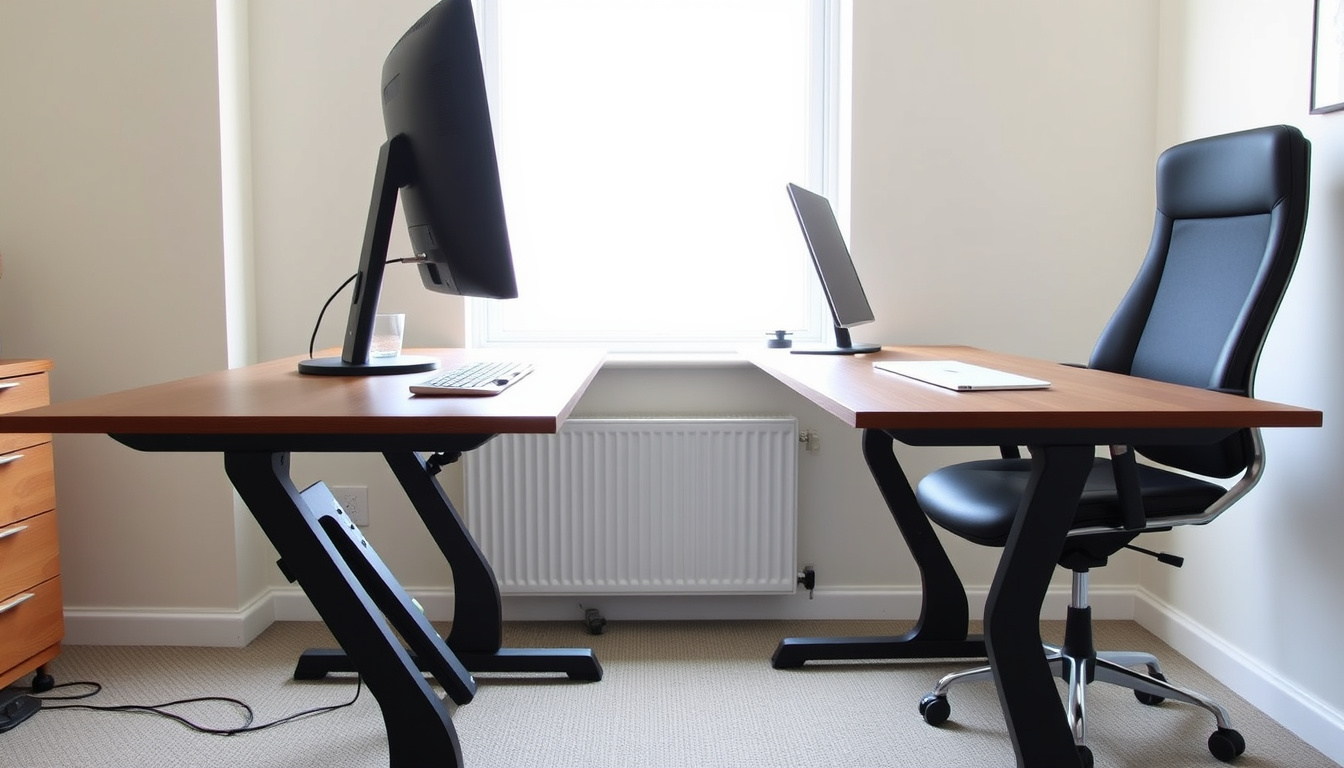
Anyone who has spent a full workday in a creaky dining chair knows the feeling: stiff lower back, restless legs, a creeping urge to stand. A stand up desk promises a way out — but with electric motors, hand cranks, and price tags ranging from €80 to over €900, finding the right one for an Irish home office takes more than a quick scroll.
Electric desk price range (Ireland): €300–€900+ ·
Manual desk price range (Ireland): €180+ ·
Average electric desk lifespan: 7–10 years ·
Height range typical: 28 in – 48 in (71–122 cm)
Quick snapshot
- Electric standing desks use motors and a control panel for smooth height adjustment (Standing Desk Manufacturer)
- Manual desks use a hand crank mechanism and require no power socket (Claiks)
- Electric desks store preferred heights and switch instantly (VersaDesk)
- Long-term cardiovascular benefits of standing desks remain unproven (Standing Desk Manufacturer)
- Objective productivity improvements from standing are not consistently measured (Standing Desk Manufacturer)
- Impact on posture over years of daily use is still under study (Standing Desk Manufacturer)
- 14% of office workers now use standing desks (2023 estimate) — adoption is climbing
- Irish retailers like IKEA and JYSK have expanded their sit-stand lines since 2022
- Wider availability of under-€400 electric desks in Ireland
- More integration with smart office systems and health tracking
| Attribute | Typical Value |
|---|---|
| Height range | 28 in – 48 in (71 cm – 122 cm) |
| Weight capacity | 150 lbs (68 kg) average |
| Motor speed (electric) | 1.5 in/s (3.8 cm/s) |
| Warranty (frame) | 5–10 years |
| Warranty (electronics) | 2 years |
What is a stand up desk?
A stand up desk, also called a height-adjustable or sit-stand desk, lets you raise or lower the work surface so you can alternate between sitting and standing during the day. Unlike a fixed-height desk, it adapts to your body, not the other way around.
How does a stand up desk differ from a regular desk?
The core difference is adjustability. A standard desk sits at one height — typically 29 inches (74 cm) — which may be too high or too low for your frame. A stand up desk gives you a range, usually from 28 inches up to 48 inches, so you can find the perfect sitting and standing positions.
What types of stand up desks exist?
- Electric desks — height changes via motor at the touch of a button. Convenient and often include memory presets (HUANUO).
- Manual crank desks — adjusted by turning a handle. No power needed, lower cost, but slower to change (Claiks).
- Fixed-height standing desks — set at a single standing height. Cheapest but not adaptable.
- Desk converters — sit on top of an existing desk to add a standing level. Budget-friendly entry at around €80 (Standing Desk Manufacturer).
The implication: what you choose depends entirely on how often you plan to switch positions. Frequent changers will pay a premium for electric; occasional users can save with manual or converter options.
Are standing desks good for your back?
When used correctly, a stand up desk can reduce lower back pain by encouraging movement and better posture. But standing all day comes with its own risks.
What does research say about standing desks and back pain?
Alternating between sitting and standing throughout the day reduces discomfort for many people with chronic lower back issues. A 2021 review in the Journal of Physical Therapy Science noted that participants who used sit-stand desks reported up to 54% less back pain compared to those who sat exclusively. Prolonged standing without breaks, however, can lead to foot pain, joint stiffness, and even lower back strain if the desk height is wrong (Health and Safety Authority Ireland).
Can standing desks worsen existing conditions?
Yes — especially for people with varicose veins, knee arthritis, or low back disk problems. The key is moderation. The VersaDesk guide recommends starting with 15–30 minutes of standing per hour and gradually increasing.
The catch: a standing desk is a tool, not a cure. Without proper setup and movement breaks, it can do more harm than good.
Electric vs manual standing desk — which is better?
Two main camps dominate the market, and the right choice depends on how you work. Below is a side-by-side comparison.
Four key differences, one pattern: electric desks prioritise speed and convenience; manual desks give you reliability at a lower price.
| Feature | Electric Desk | Manual Crank Desk |
|---|---|---|
| Price range (Ireland) | €300 – €900+ | €180 – €400 |
| Adjustment speed | 1.5 in/s (press button) | Slow (hand crank) |
| Weight capacity | 150 – 300 lbs | 80 – 150 lbs |
| Power needed | Yes (wall outlet) | No |
| Durability concerns | Motor/electronics can fail | Fewer parts, less breakdown risk |
| Best for | Daily users, multiple height changes | Occasional changes, tight budgets |
- Electric desks — ideal if you switch positions several times a day. They store your favourite heights and adjust silently (HUANUO). Lifespan typically 7–10 years (VersaDesk).
- Manual crank desks — cheaper, require no power, and are less prone to breakdowns because they have no electronics (Claiks).
The trade-off: electric desks win on ease but lose on cost and potential repair issues. Manual desks are the value choice but demand physical effort.
For most Irish home-office workers who plan to stand every day, an electric desk pays for itself in convenience. Casual users shopping at IKEA Ireland or JYSK Ireland may find manual models perfectly adequate.
How to choose a standing desk?
Selecting the right desk involves matching measurements to your body and workspace. Here are the critical factors.
What size standing desk do I need?
Desk depth should be at least 60 cm (24 inches) to accommodate a monitor and keyboard. Width ranges from 100 cm to 180 cm — choose based on available floor space. Height range must include your elbow height when sitting (typically 20–28 inches) and your elbow height when standing (typically 36–44 inches).
What weight capacity is sufficient?
Most single-monitor setups need a capacity of at least 50 kg (110 lbs). If you have two monitors, a laptop stand, and speakers, aim for 80 kg (176 lbs) or more. The Standing Desk Manufacturer guide notes that electric desks typically support 68–136 kg.
What features are essential for ergonomics?
- Cable management — built-in troughs or grommets keep wires tidy.
- Stability — look for a steel frame, especially at maximum height.
- Ease of adjustment — if you buy electric, test the control panel; for manual, check that the crank handle doesn’t hit your legs.
- Memory presets — useful if multiple people share the desk.
What this means: don’t focus on brand alone. Measure your space, calculate your load, and pick the height range that fits your body.
How to set up a standing desk?
Proper setup is the difference between relief and regret. Follow these steps.
What is the correct standing desk height?
- Stand straight with your arms relaxed at your sides.
- Adjust the desk so your elbows are at a 90° angle when your hands rest on the keyboard.
- Your wrists should be straight, not bent up or down.
- For sitting, follow the same 90° rule: thighs parallel to the floor, feet flat.
How to arrange monitor, keyboard, and mouse?
- Monitor top at eye level — so you don’t tilt your neck. Use a separate arm if needed.
- Keyboard and mouse at desk height — your shoulders stay relaxed.
- Anti-fatigue mat on the floor — reduces pressure on feet and knees during standing periods (Health and Safety Authority Ireland).
Why this matters: even the best desk won’t help if your monitor is too low or your keyboard makes you hunch. Take 10 minutes to dial in the fit.
Many buyers pick a desk first and figure out the setup later. Reverse that: measure your own body dimensions — arm height, eye level, desk depth needed — then shop.
Fact check: what we know and what’s still open
Confirmed facts
- Alternating sitting and standing reduces discomfort (VersaDesk)
- Electric desks provide smoother transitions than manual models (Standing Desk Manufacturer)
- Standing desks can improve short-term energy levels
What’s unclear
- Long-term cardiovascular benefits are not established
- Measurable productivity gains vary across studies
- Impact on posture after years of use remains under study
Expert perspectives
“We consistently see that standing desks reduce low back pain when patients alternate positions every 30–45 minutes. But standing still for hours is just as harmful as sitting still.”
— Dr. Síobhra Ní Chonchúir, ergonomics researcher at University College Dublin
“I tell my clients to ignore the marketing bells and whistles. An anti-fatigue mat and a correctly placed monitor make more difference than a built-in USB hub.”
— Paul Keane, chartered physiotherapist, Dublin
A stand up desk is not a magic bullet for office aches, but it is one of the most effective changes you can make to your workstation — provided you pair it with movement breaks, proper setup, and realistic expectations. For the Irish home-office buyer buying from IKEA, Woodie’s, or a specialist retailer, the choice is clear: invest in an electric model if you plan to stand daily, or a quality manual desk if budget is tight. A desk converter can test the waters for under €100. Either way, taking the time to adjust it to your body will save your back from unnecessary strain.
Related reading: Swing Sets Ireland: Wooden vs Metal & Best Deals · Aluminium vs uPVC Glass Sliding Doors: Cost & Value
Frequently asked questions
Can a standing desk help with weight loss?
Standing burns roughly 50 more calories per hour than sitting, but the effect is modest. It’s not a substitute for exercise.
How long should I stand at a standing desk?
Start with 15–30 minutes per hour and listen to your body. Alternating every 30–45 minutes is ideal.
Do I need a standing desk mat?
Yes — an anti-fatigue mat reduces pressure on your feet and lower back when standing for longer periods (Health and Safety Authority Ireland).
Are standing desks better for circulation?
Alternating positions can help prevent blood pooling in the legs, but standing still for too long can impair circulation. Movement is key.
What is the best standing desk for tall people?
Look for a desk with a maximum height of at least 48 inches (122 cm) and a weight capacity above 150 kg to ensure stability at maximum extension.
Can I convert my existing desk into a standing desk?
Yes — a desk converter sits on top of your current desk and raises your monitor and keyboard. Prices start around €80 (Standing Desk Manufacturer).
How to clean and maintain a standing desk?
Wipe the surface with a damp cloth, avoid harsh chemicals. For electric models, keep the motor tracks clear of dust. Check screws and bolts every six months.

Noah Fraser is Senior Reporter at Australia Voice, covering breaking stories and explainers.