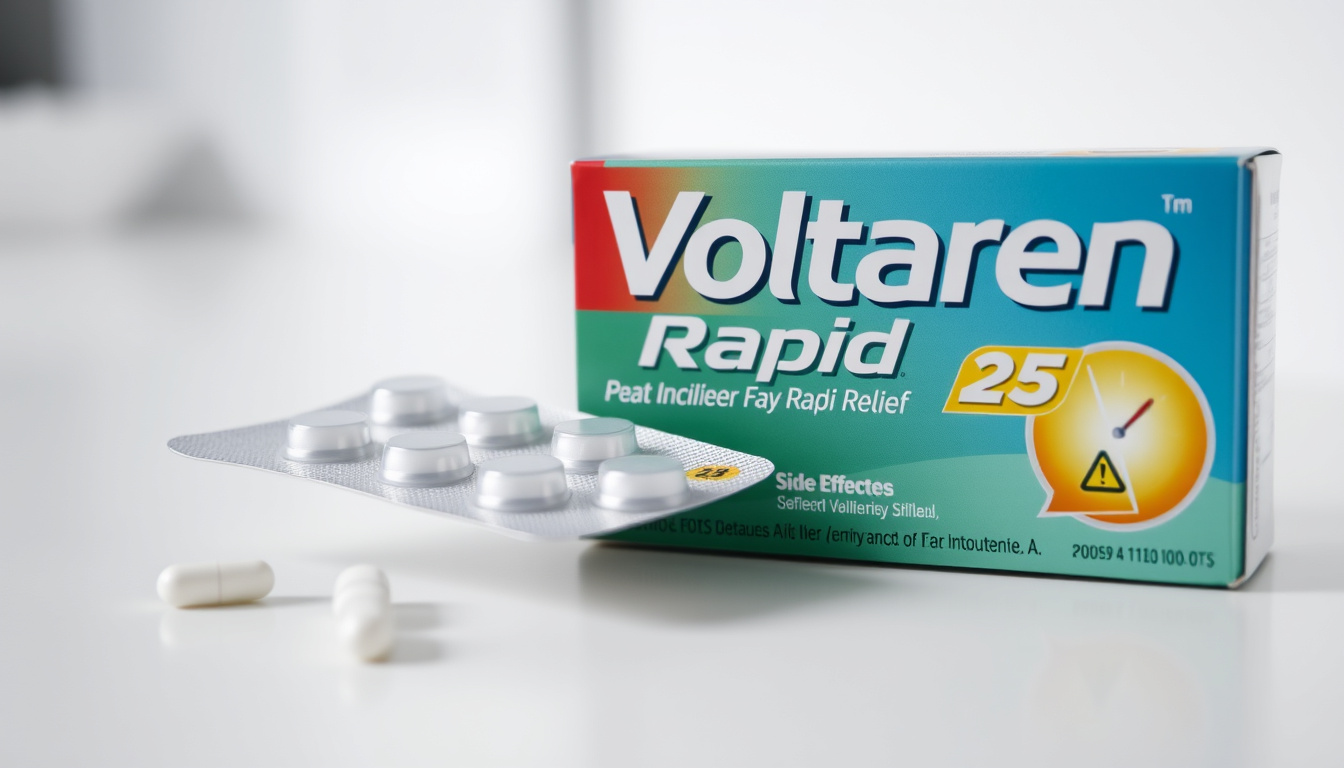

When a sprained ankle keeps you off your feet or a migraine threatens to derail your day, you want relief — fast. Voltaren Rapid 25 promises that: onset in as little as 15 minutes, according to the Therapeutic Goods Administration, making it among the speediest over-the-counter pain options available in Australia. This guide lays out what official Australian health authorities actually say about uses, dosing, and safety.
Active Ingredient: Diclofenac potassium 25 mg ·
Primary Uses: Relief of acute pain and inflammation ·
Onset Time: As fast as 15 minutes ·
Maximum Daily Dose: 8 tablets (200 mg) ·
Availability: Over-the-counter tablets
Quick snapshot
- Diclofenac potassium 25 mg per tablet (TGA ARTG)
- Max 8 tablets (200 mg) in 24 hours (NPS MedicineWise)
- For adults and children 14+ years (NPS MedicineWise)
- Exact head-to-head potency versus ibuprofen without clinical trials
- Specific interaction data with common Australian medications
- Indications approved as at 16 November 1998 for acute pain states with inflammatory component (Healthdirect)
- Short-term use only — a few days without medical advice; regular review for ongoing pain
The table below summarises the core specifications that define how Voltaren Rapid 25 behaves.
| Attribute | Details |
|---|---|
| Strength | 25 mg diclofenac potassium |
| Form | Oral tablets |
| Onset | 15 minutes |
| Duration | 4–6 hours |
| Class | NSAID |
What is Voltaren Rapid 25 mg used for?
Voltaren Rapid 25 tackles acute pain that comes with swelling — the kind that turns a simple sprain into a sleepless night. The Therapeutic Goods Administration registers it as diclofenac potassium 25 mg per tablet, and NPS MedicineWise lists it for short-term treatment (up to 1 week) of conditions including back pain, joint pain, dental pain, muscle strains, sprains, and tendinitis. It also covers menstrual cramps and migraine headaches — though not as a preventive medication. Medsinfo’s consumer medicine information confirms the migraine and period pain indications.
Conditions treated
- Back and joint pain from inflammation or degeneration
- Muscle strains and sprains
- Dental pain
- Tendinitis
- Menstrual cramps (period pain)
- Migraine headaches (acute relief only)
How it provides relief
Diclofenac, the active ingredient, belongs to the NSAID class — it works by reducing inflammation at the source, which in turn eases pain signals. NPS MedicineWise describes it as relieving both symptoms: pain and inflammation (swelling and redness). That dual action is why health authorities approve it specifically for conditions where swelling is present, not for plain headaches or mild aches without inflammation.
If your pain has visible swelling, redness, or warmth, Voltaren Rapid 25 targets the mechanism — not just the sensation. That’s the difference NSAIDs make versus paracetamol for inflammatory pain.
How many Voltaren Rapid 25 can I have?
Dosing varies by condition, and the authorities are precise: NPS MedicineWise lays out different regimens for general pain, menstrual cramps, and migraines. The maximum across all uses is 8 tablets (200 mg) in 24 hours — that ceiling applies regardless of how many migraine attacks you get in one day.
Adult dosage guidelines
For most painful conditions with inflammation, the standard approach is 2 tablets at first sign, then 1–2 tablets every 8 hours as needed. NPS MedicineWise notes this covers the initial adult daily dosage range of 100–150 mg. For milder cases or for those aged 14 and over, you can start with 1–2 tablets and drop to 1 tablet every 8 hours for ongoing relief.
Maximum daily limits
- General pain: Up to 8 tablets (200 mg) per 24 hours
- Menstrual pain: 2 tablets at first sign, up to 2 tablets three times daily
- Migraine: 2 tablets at first sign; if no relief after 2 hours, take 1–2 more; wait 4 hours before the next dose; maximum 8 tablets even across multiple attacks
The NPS PDF consumer medicine information makes the rule explicit: do not exceed 8 tablets in 24 hours for relief of any condition. For migraine specifically, the second dose waits 2 hours, and any follow-up dose waits another 4 hours. MyDr.com.au adds a caution: do not combine Voltaren Rapid with other diclofenac products or NSAIDs without medical advice.
Eight tablets sounds like a lot — but at 25 mg each, you reach 200 mg of diclofenac fast. The dosing windows (8 hours for general pain, 4 hours for migraine follow-up) exist because your liver processes this drug, not your kidneys flushing it out. Stick to the intervals, or you risk stacking doses without added relief.
How long does Voltaren Rapid take to kick in?
Fast — by OTC standards, genuinely fast. The formulation uses diclofenac potassium rather than the slower diclofenac sodium salt, and that chemical difference translates to measurable speed. Onset in as little as 15 minutes is what authorities reference for this product. Duration runs 4–6 hours per dose, which is why the every-8-hour schedule leaves a small window where the previous dose is still working.
Time to effect
Potassium salts dissolve faster than sodium salts. That’s the core reason Voltaren Rapid works faster than some older diclofenac formulations. NPS MedicineWise confirms the quick-acting profile, and TGA registration treats the 25 mg potassium formulation as distinct from standard-release diclofenac.
Factors affecting speed
- Food: Taking with food can slow absorption — take on an empty stomach for fastest relief
- Stomach contents: A full stomach delays the potassium salt dissolving
- Individual metabolism: Some people metabolise NSAIDs faster than others
Is Voltaren Rapid 25 an anti-inflammatory?
Yes — and that’s the point. Diclofenac is a non-steroidal anti-inflammatory drug (NSAID), a class that also includes ibuprofen, naproxen, and aspirin. NPS MedicineWise describes its action as relieving pain and reducing inflammation (swelling and redness). Unlike paracetamol, which addresses pain perception directly, Voltaren tackles the inflammatory cascade that causes swelling and the pain that comes with it.
Active ingredient details
Diclofenac potassium is the potassium salt of diclofenac, optimised for faster dissolution in the stomach. TGA’s ARTG entry (ID 42942) lists diclofenac potassium as the active ingredient in Voltaren Rapid Extra Strength — the 25 mg blister pack variant. The drug works by inhibiting cyclooxygenase (COX) enzymes, which interrupts the production of prostaglandins that cause pain, fever, and inflammation.
Anti-inflammatory action
When you sprain an ankle, your body floods the area with inflammatory chemicals. Those chemicals sensitise nerve endings, causing pain and swelling that compounds the original injury. Diclofenac steps in before those chemicals do their worst — which is why it works best when taken early, before inflammation fully establishes itself. Medsinfo’s consumer medicine information confirms it relieves both symptoms of pain and inflammation together.
That anti-inflammatory action comes with a trade-off: NSAIDs can mask symptoms of serious infections, according to NPS MedicineWise. If you take Voltaren Rapid 25 for pain that feels like it might be more than a strain, see a doctor — the drug might hide the signs you need to act on.
What is the biggest side effect of Voltaren?
Stomach problems lead the list — and the serious ones can be life-threatening. Medsinfo’s CMI lists common side effects including headache, dizziness, nausea, stomach pain, rashes, and indigestion. But NPS MedicineWise flags the serious end of the spectrum: severe stomach pain, vomiting blood, bleeding from the back passage, swelling of the face, lips, or tongue, and asthma or wheezing. These require immediate medical attention.
Common side effects
- Headache and dizziness
- Nausea and stomach pain
- Indigestion and loss of appetite
- Rashes, itching
- Vision problems
- Constipation or diarrhoea
- Mood changes and hair loss (less common)
Serious risks and warnings
Long-term or high-dose use carries well-documented risks. MyDr.com.au lists contraindications: allergy to diclofenac, aspirin, or other NSAIDs; active stomach ulcer; and severe heart failure. Medsinfo’s product information PDF adds caution for patients with hypertension — monitor blood pressure during treatment. NPS MedicineWise also warns that Voltaren may cause dizziness, drowsiness, or blurred vision: do not drive or operate machinery if affected.
Signs of anaemia or bleeding to watch for include unusual tiredness, shortness of breath, and bruising easily. There’s also an increased risk of sunburn symptoms, according to NPS MedicineWise — so use sunscreen while taking this medication.
The pattern is clear: gastrointestinal and cardiovascular systems bear the load. The implication for patients is straightforward — use the lowest effective dose for the shortest time, and never exceed 8 tablets in 24 hours.
Voltaren Rapid 25 vs other diclofenac tablets
The Voltaren family includes multiple strengths and formulations, and the differences matter for dosing and speed. The 25 mg tablet delivers twice the diclofenac of the 12.5 mg option, which changes how many tablets you take per dose — but not necessarily how much total daily medicine you end up with.
The comparison below shows how the two main Voltaren Rapid formulations stack up.
| Product | Strength | Key difference |
|---|---|---|
| Voltaren Rapid 25 (Extra Strength) | 25 mg diclofenac potassium | Higher strength per tablet; faster onset due to potassium salt; standard 8-hour dosing |
| Voltaren Rapid 12.5 mg | 12.5 mg diclofenac potassium | Lower strength; requires more tablets per dose; same active ingredient and class |
Voltaren.com.au’s product listing confirms the 25 mg is the Extra Strength variant in blister pack. Both products are NSAID-based and both use the potassium salt — the 25 mg simply delivers double the active dose per tablet, which matters most for how many tablets you need to reach your target dose.
General pain dosing vs migraine dosing
The regimens differ in important ways, and confusing them leads to either under-dosing or dangerous stacking. NPS MedicineWise provides separate guidance for each condition, and the migraine protocol is more complex due to the risk of over-medication during repeated attacks.
This table lays out the key differences between dosing protocols.
| Condition | Initial dose | Follow-up interval | Maximum in 24 hours |
|---|---|---|---|
| General acute pain | 2 tablets | 1–2 tablets every 8 hours | 8 tablets (200 mg) |
| Menstrual pain | 2 tablets at first sign | Up to 2 tablets three times daily | 6 tablets |
| Migraine | 2 tablets at first sign | 1–2 tablets after 2 hours if needed; 4-hour wait for next dose | 8 tablets (200 mg), even across multiple attacks |
The migraine protocol’s 4-hour subsequent wait is the key difference — it prevents rapid re-dosing during a single attack when relief doesn’t come quickly. NPS MedicineWise’s CMI PDF confirms the 2-hour second dose wait and the 4-hour subsequent wait, and explicitly states that even multiple attacks in one day count toward the 8-tablet maximum.
Upsides
- Fast onset (15 minutes) — fastest OTC NSAID option in Australia
- Approved for multiple acute pain conditions with swelling
- Over-the-counter availability without prescription
- Well-established safety profile from decades of use
- Film-coated tablets for easier swallowing (myDr.com.au medicine database)
Downsides
- Gastrointestinal risks including bleeding and ulceration
- Not for patients with NSAID allergy, active ulcers, or severe heart failure
- Can raise blood pressure — monitor if hypertensive
- May mask serious infection symptoms
- Short-term use only — a few days without medical advice
Voltaren Rapid 25 specifications
Five specifications define how Voltaren Rapid 25 behaves — from what it contains to how long it lasts.
The specifications table below captures the essential product data from regulatory records.
| Specification | Value |
|---|---|
| Active ingredient | Diclofenac potassium 25 mg |
| Form | Film-coated oral tablet |
| Product ID (ARTG) | 42942 |
| Maximum daily dose | 8 tablets (200 mg) |
| Usual adult initial daily dose | 100–150 mg |
| Onset | 15 minutes |
| Duration per dose | 4–6 hours |
| Drug class | NSAID (non-steroidal anti-inflammatory) |
| Minimum age | 14 years and over |
| Treatment duration | Short-term — up to 1 week |
| Availability | Over-the-counter in Australia |
| Regulatory status | Sponsor-restricted on ARTG |
The registration status deserves attention: TGA classifies Voltaren Rapid 25 as sponsor-restricted, meaning the manufacturer maintains specific conditions for supply. This isn’t a fully unregulated supplement — the product falls under the Australian Register of Therapeutic Goods with conditions attached.
Confirmed facts and open questions
Health authorities agree on the core facts about Voltaren Rapid 25 — but some questions remain genuinely unanswered by primary sources.
Confirmed
- Dosage from Medsafe and NPS MedicineWise datasheets
- Uses from Voltaren official sites and TGA registration
- Maximum 8 tablets (200 mg) in 24 hours
- Approved for adults and children 14+
- Indications include acute pain with inflammation since 16 November 1998
What’s unclear
- Exact strength comparisons to ibuprofen without head-to-head clinical trials
- Specific interaction data with common Australian medications (anticoagulants, blood pressure drugs)
- Precise pregnancy and breastfeeding guidance from primary sources
These medicines can relieve the symptoms of pain and inflammation but they will not cure your condition.
— NPS MedicineWise (Australian Medicines Authority)
Voltaren Rapid should not be used as a preventive medication for migraine.
— Medsinfo Consumer Medicine Information
Following an initial loading dose of 50 mg, a further dose of 25–50 mg may be taken after 2 hours if necessary.
— NPS MedicineWise CMI PDF
What this means for Australian consumers is direct: Voltaren Rapid 25 fills a gap in the OTC pain market — faster than paracetamol, targeted to inflammatory pain rather than general aches. But it’s not a long-term solution, and for anyone with stomach sensitivity, cardiovascular risk, or hypertension, a doctor’s advice belongs before the first dose.
Related reading: running shoes for injury prevention · Brisbane Broncos players
medsinfo.com.au, nps.org.au, apps.medicines.org.au, medsinfo.com.au, medsinfo.com.au, voltaren.com.au, voltaren.com.au, healthdirect.gov.au
While Voltaren Rapid 25 targets fast relief from sprains or migraines, the Voltaren 50 mg guide explores higher-dose options for ongoing inflammation.
Frequently asked questions
What is the dosage for Voltaren Rapid 25 tablets?
For most acute pain with inflammation: 2 tablets initially, then 1–2 tablets every 8 hours as needed, up to 8 tablets (200 mg) in 24 hours. For menstrual pain: 2 tablets at first sign, up to 2 tablets three times daily. For migraine: 2 tablets at first sign, 1–2 more after 2 hours if needed, then wait 4 hours — maximum 8 tablets in 24 hours regardless of how many migraine attacks occur.
Can I take Voltaren Rapid 25 with other painkillers?
Do not combine Voltaren Rapid 25 with other diclofenac products or NSAIDs without medical advice. You may be able to use it alongside paracetamol, but check with a pharmacist or doctor first, especially if you have stomach issues or take blood-thinning medications.
Who should avoid Voltaren Rapid 25?
Contraindications include allergy to diclofenac, aspirin, or other NSAIDs; active stomach ulcer; and severe heart failure. Patients with hypertension should use caution and monitor blood pressure during treatment. It is not recommended for children under 14 without medical advice. Pregnant or breastfeeding women should consult a doctor before use.
How does Voltaren Rapid 25 work?
Diclofenac, the active ingredient, is an NSAID that inhibits cyclooxygenase (COX) enzymes. This interrupts the production of prostaglandins — chemicals that cause pain, fever, and inflammation. By reducing inflammation at the source, it eases both swelling and the pain that comes with it. The potassium salt formulation dissolves faster than sodium salts, which is why onset is as quick as 15 minutes.
What are the side effects of Voltaren Rapid 25?
Common side effects include headache, dizziness, nausea, stomach pain, indigestion, rashes, and itching. More serious effects requiring immediate medical attention include severe stomach pain, vomiting blood, bleeding from the back passage, swelling of the face or tongue, and asthma or wheezing. You may also experience unusual tiredness, shortness of breath, or easy bruising — signs of anaemia or bleeding — and increased sensitivity to sunburn.
Is Voltaren Rapid 25 safe for daily use?
No — it is intended for short-term use only, up to 1 week. Using it longer without medical advice risks gastrointestinal bleeding, cardiovascular events, and kidney problems. If your pain persists beyond a few days, see a doctor for a review.
Voltaren Rapid 25 vs other diclofenac tablets?
The 25 mg (Extra Strength) variant delivers twice the diclofenac per tablet compared to the 12.5 mg option, meaning fewer tablets per dose to reach your target amount. Both use diclofenac potassium for fast onset, and both carry the same NSAID risks. The choice depends on your dosing needs and how many tablets you’re comfortable taking per dose.

Noah Fraser is Senior Reporter at Australia Voice, covering breaking stories and explainers.