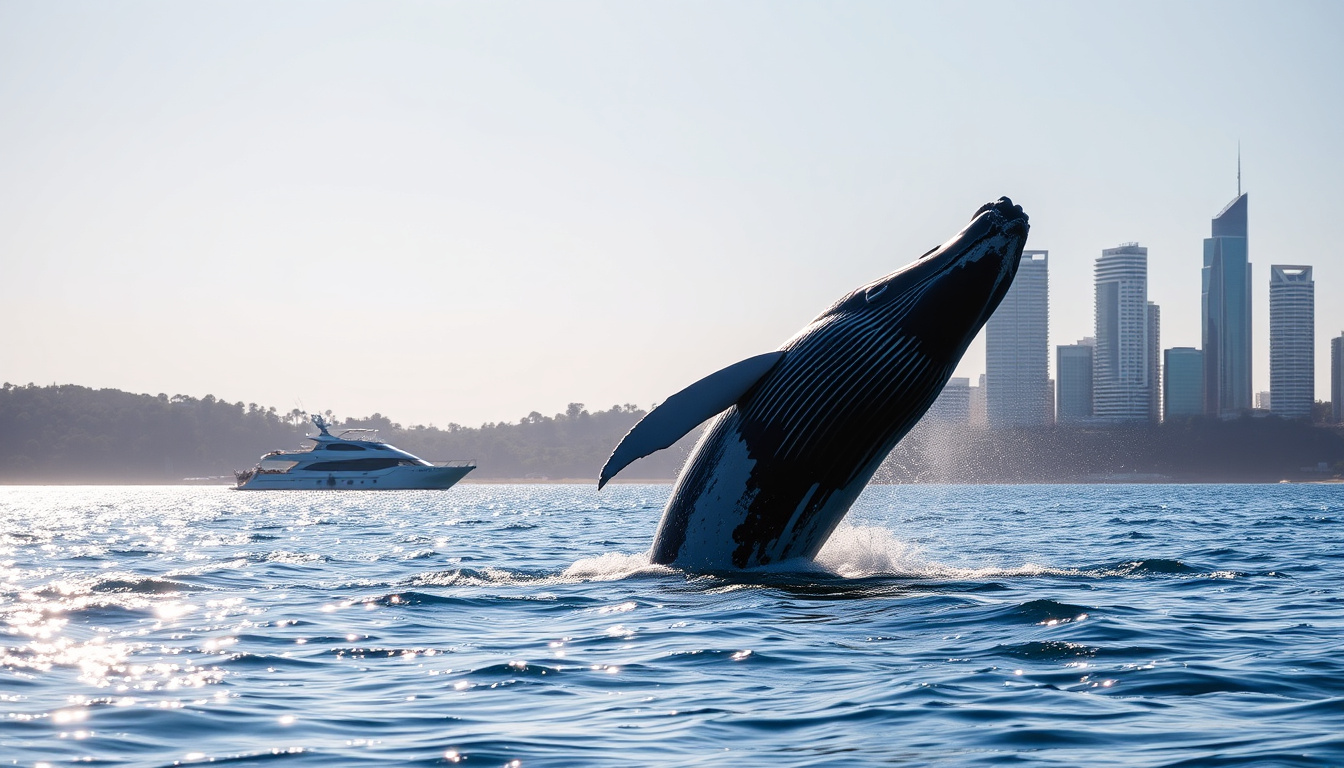
Every year along the Gold Coast, humpback whales turn an ordinary ocean trip into something unforgettable — breaching, tail-slapping, sometimes just a few kilometres from shore. This guide cuts through the booking hype to give you the real numbers on season timing, tour costs, and where to stand for the best view, so you can plan a trip that actually delivers.
Season duration: 7 months (May to November) ·
Typical tour length: 2.5 hours ·
Sighting guarantee: 100% offered by major operators ·
Adult ticket starting price: $89 AUD
Quick snapshot
- Season runs May to November (Sea World Cruises (official operator))
- Peak sightings July–September (About Australia (travel resource))
- June–August also considered peak by local tour guides (Aqua Adventures (Gold Coast tour provider))
- Adult tickets from $89 AUD on selected departures, regular $119 AUD (Sea World Cruises (Main Beach operator))
- Half-day tours typically $70–$120 AUD per person (Aquarius Traveller (travel guide))
- 100% sighting guarantee – free return cruise if no whale sighted (Sea World Cruises (certified operator))
- Standard 2.5-hour cruise from Main Beach (Sea World Cruises (Gold Coast operator))
- Some operators run longer 6-hour tours (Tripadvisor (user-reviewed listings))
- Swim-with-whales experiences around $300 AUD per person (Aquarius Traveller (travel guide))
- Point Danger is a premier land-based spot (About Australia (travel resource))
- Departure areas include Surfers Paradise and Coolangatta (Aqua Adventures (Gold Coast tour provider))
- Whales can pass within 1–2 km of shore (About Australia (travel resource))
Six key facts about the Gold Coast whale watching experience, drawn straight from operators and official sources.
| Fact | Value |
|---|---|
| Season length | 7 months (May–November) – Sea World Cruises (official operator) |
| Typical tour duration | 2.5 hours – Sea World Cruises (Gold Coast operator) |
| Sighting guarantee | 100% – Sea World Cruises (certified operator) |
| Adult ticket (discounted) | From $89 AUD – Sea World Cruises (official operator) |
| East coast whale watching window | May–July and September–November – About Australia (travel resource) |
| Peak sightings | July–September – Sea World Cruises (Gold Coast operator) |
What are the best months for whale watching on the Gold Coast?
Peak season: June to August
June, July and August deliver the highest concentration of humpback whales because the main migration stream is passing the Gold Coast. Sea World Cruises (Gold Coast operator) reports peak sightings from July through September, while Aqua Adventures (local tour provider) agrees that June–August sees the most whales per trip.
Shoulder months: May and September–October
Early May and late October are less crowded on the water, and you still see consistent whale activity as the migration ramps up and tapers off. About Australia (travel resource) notes that the east coast window runs May–July and September–November, giving you two solid shoulder windows.
Why November is still viable
By November, the tail end of the migration is still active. Many southern-bound whales pass the Gold Coast, and the warmer weather makes for a more comfortable trip. Most operators, including Aqua Adventures (Gold Coast tour provider), run tours until early November.
The implication: if you want maximum whale volume, target July–August; if you prefer quieter waters, choose May or September–October.
How much does it cost to go whale watching on the Gold Coast?
Standard adult ticket prices
Most half-day tours fall between $70 and $120 AUD per adult. Sea World Cruises (official operator) lists a regular adult ticket at $119 AUD, with discounted departures from $89 AUD. Aquarius Traveller (independent travel guide) confirms a similar range, noting $70–$120 for most half-day trips.
Discount deals and cheap options
Look for early-bird or off-peak discounts directly on operator websites. Sea World Cruises’ “best available” price of $89 AUD is a common entry point. Some third-party booking sites occasionally lower rates further, though the difference is usually small.
What’s included in the price
A standard ticket covers the cruise, onboard commentary, and basic safety equipment. Swimming-with-whales experiences, which Aquarius Traveller (travel guide) prices at around $300 AUD per person, include a longer trip and snorkel gear. Free return cruises often apply if no whale is sighted.
What this means: the base ticket gives you a solid experience. Upgrades mainly add duration or a swim component.
Cheap deals ($89–$99 AUD) get you the same 2.5-hour cruise and the same 100% sighting guarantee as full-price tickets — but you may have to choose a less popular departure time.
Where is the best place to see whales on the Gold Coast?
Top whale watching tour operators
Sea World Cruises (Main Beach operator) is the closest departure point to the main migration channel, with a 2.5-hour cruise from Sea World. Aqua Adventures (Gold Coast tour provider) mentions Surfers Paradise and Coolangatta as other common departure areas.
Best shore-based viewing spots
If you want to stay on land, About Australia (travel resource) highlights Point Danger at the southern end of the Gold Coast as a premier spot, along with Burleigh Hill and Miami Hill. Because whales often pass within 1–2 km of the beach, a pair of binoculars can be enough.
Why the ‘Humpback Highway’ runs close to Gold Coast
The Gold Coast sits right on the east Australian migration corridor, known as the Humpback Highway. The continental shelf comes close to shore here, forcing whales to swim nearer the coastline than they do in deeper-water regions. That’s why sighting rates are consistently high.
The pattern: tour operators offer the highest probability of close encounters, but land spots like Point Danger are reliable alternatives at zero cost.
Is morning or afternoon better for whale watching?
Pros of morning tours
Morning trips typically have calmer seas because the afternoon sea breeze hasn’t kicked in yet. Aqua Adventures (Gold Coast tour provider) recommends morning for better visibility and less chop.
Pros of afternoon tours
Afternoon tours often experience warmer air temperatures, and some operators note that whales tend to be more active on the surface in the warmer part of the day – breaching and tail-slapping become more common. Sighting success remains high regardless of time.
Visibility and sea conditions
Both windows have high sighting success – most operators hover around 99–100% thanks to the guaranteed return policy. The trade-off is comfort: morning can be windier, afternoon can be hotter. Check the Bureau of Meteorology (Australia weather service) forecast the day before.
The pattern: there’s no wrong time on the Gold Coast. If you prefer smooth sailing, go early. If you want optimal warmth and surface action, book the afternoon.
Are there safety concerns like sharks when whale watching?
Shark presence off the Gold Coast
Sharks do inhabit Gold Coast waters, but attacks on whale watching boats are extremely rare. The migration route attracts prey fish, which in turn draw sharks, but operators maintain constant lookout and follow strict marine safety protocols. Sea World Cruises (certified operator) follows Queensland marine park guidelines.
Tour operator safety measures
Whale watching vessels are equipped with life jackets, radios, and first-aid kits. Crews are trained in wildlife interaction rules, keeping a respectful distance from whales while keeping passengers safe. No direct shark interaction occurs during a standard tour.
Is it safe to see whales from boats?
Yes. Humpback whales are not aggressive toward boats during migration. The main safety factor is sea condition, not marine predators. Operators will cancel or reroute tours if the weather turns bad. Tripadvisor (user-reviewed listings) shows consistent positive safety ratings for Gold Coast whale watching.
The catch: actual risk from marine predators is minimal; the real variable is weather.
How to prepare for a whale watching tour
- Book in advance – especially for peak months (July–August). Sea World Cruises (official operator) allows online bookings and often sells out on weekends.
- Choose your time slot – morning for calm seas, afternoon for warmer conditions and more surface activity.
- Pack essentials – sunscreen, hat, sunglasses, a light jacket (wind can be cool even in summer), and seasickness tablets if you’re prone. Aquarius Traveller (travel guide) recommends a waterproof camera.
- Arrive 20–30 minutes early for check-in, boarding, and safety briefing. The total experience can take 4 hours including transit and waiting time.
- Check the weather – BOM (Australia weather service) provides Gold Coast marine forecasts. If rain or high winds are predicted, reschedule.
Confirmed facts & what’s unclear
Confirmed facts
- Humpback whales migrate along the Gold Coast from May to November (Sea World Cruises)
- Sea World Whale Watch offers a 100% sighting guarantee (Sea World Cruises)
- The Gold Coast has the longest continuous whale watching season in Australia (About Australia)
What’s unclear
- Exact peak of migration varies each year
- Morning vs afternoon advantage may differ day-to-day
- Effect of shark presence on whale behavior is not well documented
What operators say
“We offer a 100% whale-sighting guarantee. If no whale is sighted on your cruise, you’ll receive a free return cruise valid for 12 months.”
— Sea World Cruises (official Gold Coast operator)
“The best time to embark on a Gold Coast whale tour is between late May and early November, with peak months June to August.”
— Aqua Adventures (Gold Coast tour provider)
“Point Danger is a premier land-based whale-watching spot on the southern end of the Gold Coast, with Burleigh Hill and Miami Hill also offering good vantage points.”
— About Australia (travel resource)
For anyone planning a Gold Coast whale watching trip, the decision is simple: book between July and September for peak numbers, choose a morning tour for calm seas or afternoon for warmer surface activity, and look for discounted tickets from $89 AUD to save. For the budget-conscious traveller, shore spots like Point Danger deliver the same whales for free — just bring binoculars. The Gold Coast’s unique position on the Humpback Highway means you’re almost guaranteed a show, no matter when you go.
For those seeking an alternative to the Gold Coast, Hervey Bay whale watching offers a similarly spectacular experience during the same migration season.
Frequently asked questions
Do I need to book whale watching in advance?
Yes, especially during peak season (June–August). Operators often sell out days in advance. Booking online secures your spot and sometimes gets you a better price.
What should I wear for whale watching?
Dress in layers – it can be cool and windy on the water even in summer. Bring a light jacket, hat, sunglasses, and sunscreen. Non-slip shoes are a plus.
Can I take photos from the boat?
Absolutely. Most operators have open decks with rails. A zoom lens (70-200mm equivalent) works well for close-ups, but even a phone can capture breaching shots.
Are there whale watching tours for children?
Yes, all major operators welcome children. Family packages are often available. Kids under 4 sometimes go free.
What else can I see besides whales?
Dolphins, sea turtles, seabirds, and occasionally manta rays are common sightings. The Gold Coast’s marine ecosystem is active year-round.
Can I see whales from the Gold Coast shoreline?
Yes. Point Danger, Burleigh Hill, and Miami Hill offer excellent land-based viewing. Whales often pass within 1–2 km of the beach, so binoculars help.
What happens if no whales are spotted?
Most operators, including Sea World Cruises, offer a free return cruise valid for 12 months. Sighting success rates exceed 99% during season.
Related reading: Waterfalls Near Me – Best Swimming Spots Sunshine Coast · Halls Gap Accommodation – From Budget Motels to Luxury Chalets

Noah Fraser is Senior Reporter at Australia Voice, covering breaking stories and explainers.