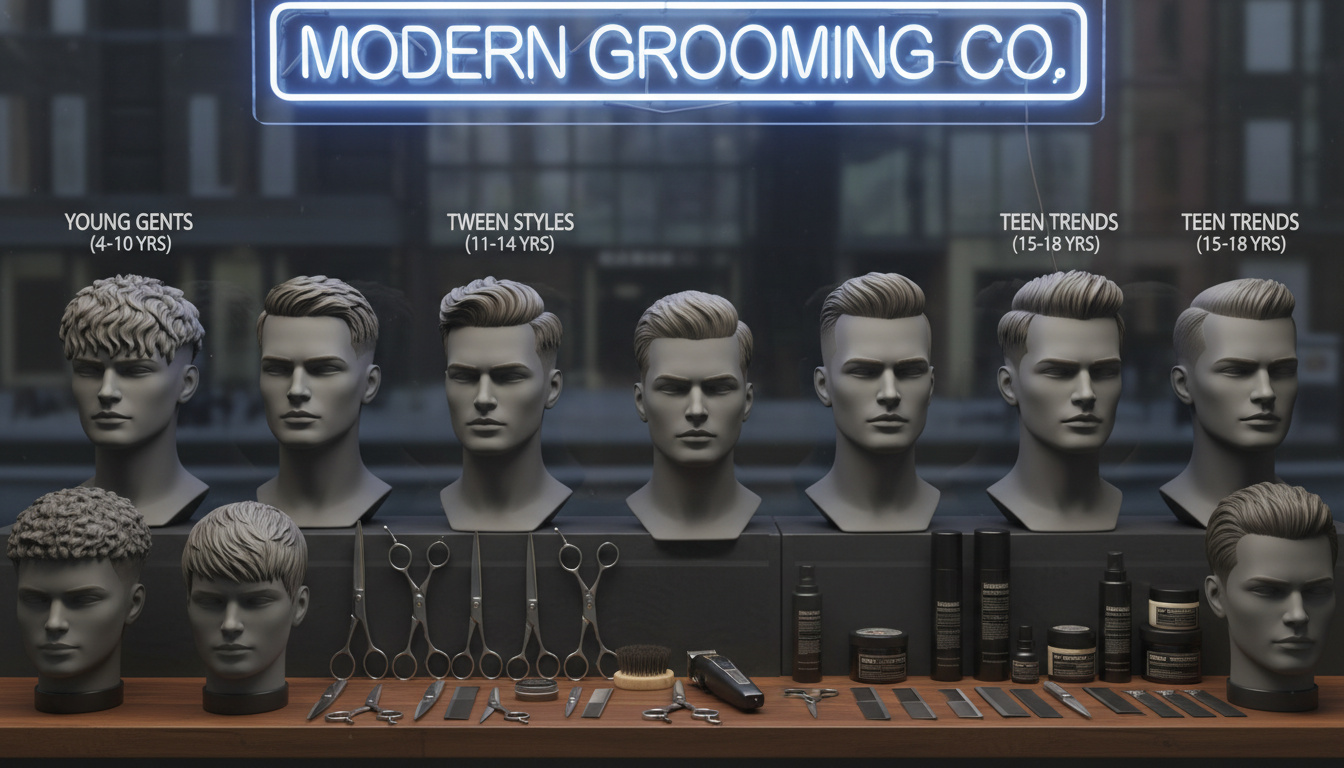
Boys’ haircut styles for 2025-2026 favor textured tops paired with precise fades, drawing influence from TikTok trends and celebrity icons like Finn Wolfhard and Josh Richards. The movement emphasizes versatility across age groups, with particular attention to curly hair adaptations such as the viral Broccoli Cut. These styles balance aesthetic boldness with practical maintenance schedules suited for active school schedules and sports participation.
Current preferences split between low-maintenance classics and fashion-forward statements. The Top 7 High School Teenage Boys Most Popular Haircuts Hairstyles 2025 highlights textured fringes and volumized crops dominating high school hallways, while younger boys increasingly wear sharp crew cuts and buzz styles that minimize morning styling time.
Face shape compatibility and hair texture now drive style selection more than uniform trends. Barbers report that oval and square faces accommodate most cuts, while round faces benefit from height-adding undercuts. The shift reflects a broader move toward individualized grooming rather than one-size-fits-all approaches.
What Are the Best and Most Popular Boys Haircut Styles?
Four cuts currently define the landscape of boys’ hair fashion, each serving different lifestyle needs and aesthetic preferences. These styles appear consistently across barbershop request lists and social media trend reports.
Short, even all-over length with slight tapering. Suits active boys aged 5-10 and athletes requiring minimal styling. Works with all face shapes.
Messy layered fringe swept forward with clean faded sides. Ideal for straight or wavy hair. Requires trimming every 2-3 weeks.
Voluminous curly top resembling broccoli florets with tapered sides. Viral TikTok trend for thick curly hair. Bold statement style.
Longer textured top with faded sides. Adds height and suits wavy or curly textures. Requires blow-drying for volume.
Key Insights on Current Trends
- Faded sides appear in approximately 60% of requested cuts, reflecting a preference for sharp contrast and clean lines.
- TikTok drives rapid adoption of styles like the Broccoli Cut, with visual tutorials amassing millions of views among teen demographics.
- Celebrity influence from actors Finn Wolfhard and Jack Dylan Grazer shapes medium-length textured preferences.
- Low-maintenance options surge among parents of children under 10, prioritizing wash-and-wear convenience.
- Curly hair adaptations now emphasize natural volume rather than flattening or straightening techniques.
- Face shape analysis determines style success, with undercuts recommended for round faces and fringes for angular features.
- Maintenance intervals typically range from 2-3 weeks for fades to 4-6 weeks for longer textured styles.
Style Comparison Guide
| Style | Ideal Hair Type | Best Age Range | Maintenance Level | Signature Feature |
|---|---|---|---|---|
| Textured Fringe/Fade | Straight/Wavy | All ages | High (2-3 weeks) | Layered front, tapered sides |
| Broccoli Cut | Thick Curly | Teens/Pre-teens | Medium | Fluffy top, skin fade sides |
| Crew Cut | Any type | 5-10 years | Minimal | Short, even length |
| Curly Undercut | Thick Curly | Teens | High | Contrast between top volume and short sides |
| Shaggy Mop | Wavy/Straight | Teens | Low | Tousled, beachy layers |
| Buzz Cut | Any type | All ages | Minimal | Uniform short length |
| Pompadour | Wavy/Curly | Teens | Medium | Voluminous, height-focused top |
What Is the Best Haircut for Boys by Age Group?
Age significantly influences appropriate style selection, balancing practical needs against social expression. Younger children benefit from utilitarian cuts that withstand playground activity, while teenagers utilize hairstyles as identity markers within social groups.
Little Boys (Ages 5-10)
Children in this bracket require cuts that accommodate physical play without constant interference. The Cool Haircuts for Boys in 2025: The Ultimate Guide to Trendy Look identifies buzz cuts, crew cuts, and short textured crops as optimal for this demographic. These styles naturally highlight facial features without requiring styling products or morning preparation time.
The bowl cut maintains relevance for this age group, offering neat perimeter lines while keeping hair out of eyes during sports. Short Caesar styles provide slightly more length on top for texture while maintaining the practical benefits of shorter sides.
For active boys under 10, prioritize cuts that dry naturally without product. Styles requiring blow-drying or pomade rarely sustain through a full school day of running and playground activity.
Teenage Boys
Adolescents gravitate toward bolder expressions, with Top 7 High School Teenage Boys Most Popular Haircuts Hairstyles 2025 noting the rise of fringe tapers, broccoli cuts, and surfer shags. These styles accommodate medium to longer hair lengths while maintaining enough structure for school dress codes.
The faux hawk and volumized undercuts offer compromise solutions—expressive enough for social media presentation but restrained enough for academic environments. Teenage cuts typically require more frequent maintenance, with fades needing refreshment every two weeks to maintain sharp lines.
What Are the Best Boys Haircuts for Different Hair Types?
Hair texture determines which styles execute successfully without daily frustration. Curly hair requires specific architectural approaches that prevent the triangular silhouette or excessive bulk, while straight hair benefits from layering techniques that add movement.
Thick Curly Hair
The Broccoli Cut represents the most significant curly-hair innovation for 2025, featuring a voluminous top resembling broccoli florets contrasted against tapered or faded sides. Barbers at Rush emphasize that this style enhances natural texture rather than fighting it, utilizing the hair’s inherent spring for the signature silhouette.
Curly undercuts provide alternative architecture, keeping curls concentrated on top where they receive definition through leave-in conditioners, while sides remain cropped short to reduce overall volume. This approach suits teens with 3B curl patterns seeking manageable yet expressive styles.
Maintenance for curly styles requires daily moisturizing and wide-tooth combing to prevent frizz. Flat styles that suppress curl patterns generally prove unsustainable and counterproductive for this hair type.
Hydration proves essential for defined curls. Leave-in conditioners and curl creams maintain the Broccoli Cut’s signature volume without frizz, while regular detangling prevents matting at the nape.
Straight or Wavy Hair
Textured fringes and crops dominate straight-hair preferences, utilizing point-cutting techniques to create movement without obvious layering. Judes Barbershop recommends lightweight mousses or matte clays to enhance these textures without the helmet-like rigidity of heavy gels.
Wavy hair accommodates pompadour variations and shaggy mops, leveraging natural wave patterns for volume without heat styling. The surfer shag specifically suits wavy textures, requiring only air-drying and minimal product to achieve the tousled aesthetic.
What Are the Trendiest Boys Haircut Styles for 2025?
Forecasting into 2025-2026 reveals continued emphasis on high-contrast cuts with substantial volume on top and aggressively tapered sides. Style forecasts indicate these hybrid fades will dominate across age groups, adapting to various hair textures through customized graduation techniques.
The integration of skater aesthetics—messy, medium-length textures—with precise barbering creates the “organized chaos” look appearing in viral tutorial videos. This style bridges the gap between parent-approved neatness and teen-desired edginess.
Celebrity influence continues driving adoption rates, with actors from Stranger Things and TikTok creators like Josh Richards normalizing longer, textured tops that require blow-drying for maximum volume. The trend toward individual expression suggests fewer universal “mandatory” styles and more personalized adaptations of classic templates.
Trendy styles with skin fades or precise lines require salon visits every 14-21 days. Families should budget accordingly, as these cuts lose their intended shape quickly as hair grows.
How Have Boys Haircut Styles Evolved Over Time?
The trajectory of boys’ hair fashion shows increasing acceptance of texture and length compared to previous decades.
- : Buzz cuts and basic induction fades dominated, emphasizing military neatness and minimal styling requirements.
- : Undercuts emerged as the defining teen style, with dramatic contrasts between clipper-short sides and longer, slicked-back tops.
- : Textured crops and messy fringes gained prominence, influenced by Korean pop culture and European soccer players.
- : The Broccoli Cut went viral on TikTok, marking the first major trend originating from social media rather than celebrity or sports figures.
- : Hybrid fades combining voluminous tops with artistic taper designs forecast as the next evolution, emphasizing personalized barbering artistry.
Which Haircut Recommendations Are Established vs. Emerging?
| Time-Tested Standards | Trending/Uncertain Territory |
|---|---|
| Crew cuts suit all face shapes and require minimal maintenance | Extreme color applications in primary/secondary schools remain institution-dependent |
| Buzz cuts provide the most practical solution for sports participation | Wolf cuts (shaggy mullets) show declining adoption after 2023 peak |
| Basic fades maintain professional acceptance across educational settings | Asymmetric designs and hair tattoos face varying dress code restrictions |
| Textured crops work reliably for straight and wavy hair types | Broccoli Cut longevity beyond 2025 remains unconfirmed by longitudinal data |
Why Do Specific Haircuts Dominate Boys’ Fashion?
Cultural shifts toward individual expression enable diversity in boys’ hairstyles that previous generations rarely accessed. Where school administrators once enforced short, uniform cuts, contemporary dress codes increasingly permit textured and longer styles provided they remain clean and non-distracting.
Practical factors simultaneously influence selections. Hot climates and active sports schedules drive demand for cuts that prevent overheating while maintaining enough length for sun protection. Barbers report that parents prioritize wash-and-wear convenience during academic semesters, reserving high-maintenance experimental styles for summer breaks.
Media representation normalizes variety. Where previous decades offered limited male hair role models, current streaming and social platforms display dozens of acceptable configurations, allowing boys to select styles that complement specific facial structures rather than conforming to singular trends.
What Do Professional Barbers Recommend?
Expert consensus emphasizes matching lifestyle to maintenance requirements before selecting aesthetic styles.
“Layered for texture, fade for sharpness. The combination creates visual interest without requiring twenty minutes of styling each morning.”
— Judes Barbershop Styling Team
“Matte clay enhances a choppy top better than pomade for school-age boys. It provides hold without the wet look that appears greasy by noon.”
— Rush UK Barbering Experts
“Broccoli embraces curls boldly. Rather than fighting the natural pattern, we build the cut around the coil structure.”
— Pete & Pedro Style Guide
Tutorials from professional stylists consistently demonstrate blow-drying techniques for adding volume to pompadours and textured tops, noting that airflow direction determines lasting lift.
How Can You Select the Right Boys Haircut?
Selecting the right boys haircut requires balancing three factors: the child’s daily activity level, their hair’s natural texture and growth patterns, and the family’s maintenance budget. Active boys under ten generally benefit from crew cuts or buzz styles that require no product and minimal trimming. Teenagers with straight or wavy hair can experiment with textured fringes, while those with curly hair achieve best results from volume-embracing cuts like the Broccoli Cut or curly undercut. Consultation with a barber experienced in the specific style—ideally viewing photos of the desired outcome—prevents miscommunication and ensures the technical requirements match the hair type.
Frequently Asked Questions
How often should boys get haircuts?
Maintenance schedules vary by style. Fades and textured fringes require trimming every 2-3 weeks to maintain sharp lines. Longer styles like shaggy mops or crew cuts extend to 4-6 weeks between visits.
What styling products work best for boys?
Lightweight creams and matte clays suit most school-age styles, providing texture without rigidity. Curly hair requires leave-in conditioners and curl creams. Heavy gels generally prove unnecessary and create helmet-like stiffness.
Can boys with curly hair wear short cuts?
Yes, though the approach differs from straight hair. Curly buzz cuts or short fro styles work well, but maintaining some length on top usually provides better visual balance than uniform short lengths.
Are long haircuts appropriate for school?
Most schools accept medium-length styles like surfer shags provided hair remains clean and doesn’t obscure eyes. Extreme length may violate specific dress codes; checking individual school policies remains advisable before committing.
How do you communicate desired styles to barbers?
Bring reference photos showing multiple angles. Specify the guard length desired for sides (e.g., #1, #2) and indicate whether you want a skin fade or standard taper. Describe daily styling time available.
What cuts require the least maintenance?
Buzz cuts and crew cuts demand essentially zero daily styling. These uniform short styles suit sports participation and hot climates while requiring only occasional trimming to maintain shape.
How do you prevent frizz in curly boys’ haircuts?
Daily moisturizing with curl-specific products prevents frizz. Using a wide-tooth comb rather than brushes maintains curl definition. Sleeping on silk or satin pillowcases reduces overnight friction and tangling.

Charlotte Singh covers culture, lifestyle and society across Australia for Australia Voice.