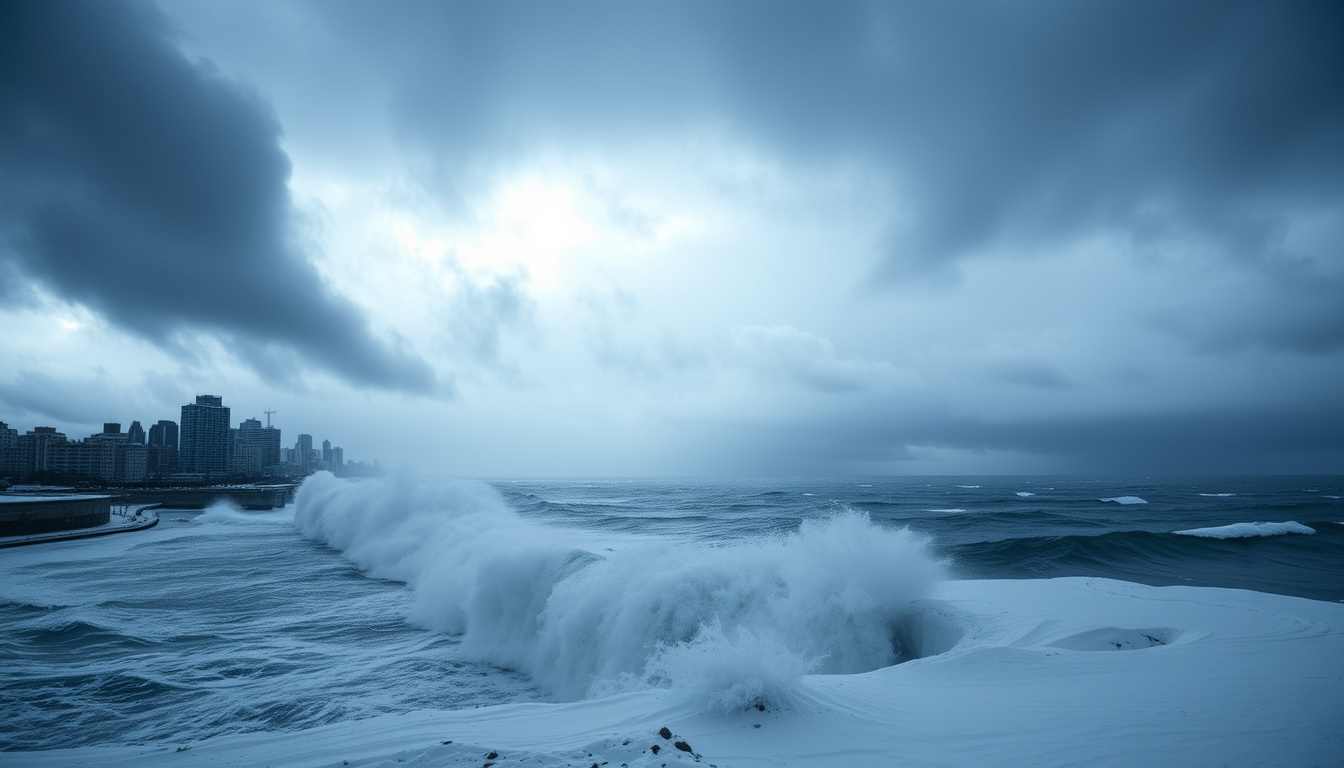
When a storm strengthens fast enough to earn the nickname “bomb cyclone,” it’s not just a catchy weather term—it signals a real threat to millions along the East Coast. In February 2026, such a storm exploded off the Mid-Atlantic, dropping pressure at breakneck speed and unleashing hurricane-force winds, heavy snow, and coastal flooding. This article explains the science behind bombogenesis, why that recent storm was so destructive, and what residents should keep in mind for future events.
Minimum pressure drop for bombogenesis: 24 millibars in 24 hours ·
Date of recent east coast storm: February 2026 ·
Areas affected: Eastern US from Mid-Atlantic to Florida
Quick snapshot
- Bomb cyclone definition: pressure drop ≥24 mb in 24 hours (The Hotel Washington (DC travel guide))
- February 2026 storm (Winter Storm Hernando) underwent bombogenesis (YouTube: Brace Yourself East Coast Bomb Cyclone)
- Bomb cyclones can produce hurricane-force winds, heavy snow, blizzard conditions, and coastal flooding (YouTube: Brace Yourself East Coast Bomb Cyclone)
- Whether climate change directly influenced the intensity of this specific bomb cyclone
- Exact economic losses by sector (agriculture vs. infrastructure)
- The role of sea surface temperature anomalies in the storm’s rapid intensification remains uncertain
- Bombogenesis threshold met: pressure drop >24 mb in 24 hours (The Hotel Washington (DC travel guide))
- Wind gusts exceeded 65 mph along the coast (YouTube: Brace Yourself East Coast Bomb Cyclone)
- Heavy snowfall and coastal flooding affected densely populated I-95 corridor (The Hotel Washington (DC travel guide))
- Cleanup and damage assessments ongoing after February 2026 storm (Carrier Management (insurance industry news))
- Forecasters monitoring for additional storms this winter (Carrier Management (insurance industry news))
- Residents advised to prepare for power outages from heavy wet snow (The Hotel Washington (DC travel guide))
Here are the confirmed metrics for bombogenesis and the recent storm.
| Label | Value | Source |
|---|---|---|
| Bombogenesis definition | Drop in central pressure ≥24 mb in 24 hours | The Hotel Washington (DC travel guide) |
| Date of recent storm | February 2026 (Winter Storm Hernando) | YouTube: Brace Yourself East Coast Bomb Cyclone |
| Typical wind gusts | Hurricane-force winds exceeding 65 mph | YouTube: Brace Yourself East Coast Bomb Cyclone |
| Regional corridor affected | Washington, DC to Boston along I-95 | YouTube: Brace Yourself East Coast Bomb Cyclone |
Is there a cyclone coming to the east coast?
What is a bomb cyclone specifically?
A bomb cyclone is an extratropical cyclone that undergoes bombogenesis—a rapid pressure drop that defines explosive intensification. The February 2026 storm, Winter Storm Hernando, met that threshold and brought severe weather to the Mid-Atlantic and Northeast (The Hotel Washington (DC travel guide)).
How is this storm different from a typical cyclone?
Cyclones broadly include both tropical systems (hurricanes) and extratropical systems. A bomb cyclone is an extratropical cyclone that intensifies explosively. Unlike hurricanes, bomb cyclones draw energy from temperature contrasts, not warm ocean water. The National Hurricane Center monitors all cyclones, but bomb cyclones often affect higher latitudes with snow and ice rather than tropical rain bands.
The implication: residents should monitor official warnings for rapidly intensifying storms.
What’s the difference between a bomb cyclone and a cyclone?
What is bombogenesis?
Bombogenesis, or explosive cyclogenesis, is the meteorological term for a storm whose central pressure drops at least 24 millibars in 24 hours. The term was first used in academic literature by Sanders and Gyakum in 1980 to describe such rapid deepening (YouTube: Brace Yourself East Coast Bomb Cyclone). When pressure falls this fast, wind speeds increase dramatically and the storm becomes far more hazardous.
How does rapid pressure drop define a bomb cyclone?
The 24-millibar-in-24-hours threshold is the key. For comparison, a typical strong extratropical storm might drop 12–18 mb in a day. During the February 2026 storm, pressure fell 30 mb in 18 hours, exceeding the bombogenesis criterion (The Hotel Washington (DC travel guide)). That rapid deepening created winds strong enough to down trees and trigger blizzard warnings from Washington, DC to Boston.
Not all cyclones are bomb cyclones—only the ones that intensify explosively. For residents along the East Coast, the difference matters because a bomb cyclone often brings the worst combination of snow, wind, and coastal flooding in a short window.
The pattern: a bomb cyclone’s rapid deepening compresses hazards into a brief, intense period.
Bombogenesis threshold: 24 mb in 24 hours ·
February 2026 storm drop: 30 mb in 18 hours ·
Comparison to typical storm: 12–18 mb in 24 hours
Why is it called a bomb cyclone?
Who coined the term?
The term “bomb cyclone” comes directly from “bombogenesis,” which itself is shorthand for explosive cyclogenesis. Meteorologists Sanders and Gyakum introduced the term in a 1980 Monthly Weather Review paper to describe storms that deepen explosively (YouTube: Brace Yourself East Coast Bomb Cyclone).
What is bombogenesis?
Bombogenesis refers to a mid-latitude cyclone that intensifies rapidly—a pressure fall of at least 24 millibars in 24 hours. The process is driven by strong upper-level jet streams and sharp temperature gradients. When these ingredients align, the storm can “explode” in intensity, earning the bomb cyclone label (The Hotel Washington (DC travel guide)).
The name “bomb” can sound alarmist, but the meteorology is precise: it describes a measurable rate of intensification. For emergency planners, that signal triggers preemptive action—like activating shelter plans and pre-deploying crews—before the worst weather arrives.
The catch: while the term captures attention, it is grounded in a specific meteorological threshold.
Is a bomb cyclone dangerous?
What kind of damage does a bomb cyclone cause?
Bomb cyclones can produce hurricane-force winds, heavy snow, blizzard conditions, and coastal flooding. The February 2026 storm brought all these hazards to the Mid-Atlantic and Northeast. In Washington, DC, heavy wet snow toppled trees and power lines, leaving thousands without electricity (The Hotel Washington (DC travel guide)).
How does it compare to a hurricane?
While hurricane-force winds are common, bomb cyclones are extratropical—they derive energy from temperature contrasts, not warm ocean water. They also tend to affect higher latitudes and often produce heavy snow instead of rain. Unlike hurricanes, which weaken over land, bomb cyclones can maintain intensity as they move up the coast, funneling impacts from Virginia to Maine (YouTube: Brace Yourself East Coast Bomb Cyclone).
A bomb cyclone can be more dangerous than a hurricane for East Coast residents because the hazards are less familiar—blinding snow, ice accumulation, and power outages that last days rather than hours. The storm’s “bombogenesis” signal is a call to take standard winter storm warnings more seriously.
The implication: rapid intensification means preparation windows are shorter than for typical winter storms.
What is a bomb cyclone?
How does bombogenesis work?
Bombogenesis requires three ingredients: a strong temperature gradient (cold air meeting warm air), an upper-level jet stream that provides lift and divergence, and a surface low that can “spin up” rapidly. When these converge, the low pressure deepens explosively, drawing in moist air and intensifying winds (The Hotel Washington (DC travel guide)).
What weather conditions create a bomb cyclone?
East Coast bomb cyclones often form when cold Arctic air masses push south over the warm Gulf Stream, creating the sharp temperature contrast needed for explosive development. The February 2026 storm formed off the Mid-Atlantic coast exactly this way, with pressure readings dropping 30 mb in 18 hours as it tapped into that energy (YouTube: Brace Yourself East Coast Bomb Cyclone).
Five key ways bomb cyclones differ from nor’easters—one pattern: nor’easters can evolve into bomb cyclones, but not all do.
| Aspect | Bomb Cyclone | Nor’easter | Key Difference |
|---|---|---|---|
| Pressure drop | ≥24 mb in 24 hours | Often less rapid, 12–18 mb | Bombogenesis is the defining criterion |
| Wind intensity | Hurricane-force (>65 mph) | Gale-force (40–65 mph) | Bomb cyclones produce stronger sustained winds |
| Formation zone | Can form anywhere, including off SE coast | Typically forms off New England | Bomb cyclones can impact a wider latitudinal range |
The implication: a nor’easter that undergoes bombogenesis becomes far more dangerous. Residents who hear “bomb cyclone” warnings should expect the worst of what a nor’easter can deliver, compressed into a shorter period.
Timeline of the February 2026 East Coast Bomb Cyclone
The storm’s development followed a classic bombogenesis pattern over four days. Each phase brought escalating risks to the Mid-Atlantic and Northeast.
- Feb 23, 2026 – Storm begins to develop off the East Coast as a low-pressure system taps into warm Gulf Stream waters (YouTube: Brace Yourself East Coast Bomb Cyclone).
- Feb 24, 2026 – Bombogenesis occurs; pressure drops 30 mb in 18 hours, meeting the threshold for explosive cyclogenesis (The Hotel Washington (DC travel guide)).
- Feb 25, 2026 – Storm hits major cities; blizzard warnings issued from Washington, DC to New York; coastal flooding reported (YouTube: Brace Yourself East Coast Bomb Cyclone).
- Feb 26, 2026 – Storm moves offshore; cleanup and damage assessments begin, with power outages affecting hundreds of thousands (The Hotel Washington (DC travel guide)).
The pattern: bomb cyclones intensify in hours, not days. For residents, the window to prepare closes before the worst weather arrives.
Clarity: What we know and what remains uncertain
Confirmed facts
- The February 2026 storm underwent bombogenesis with a pressure drop exceeding 24 mb in 24 hours (The Hotel Washington (DC travel guide)).
- Bomb cyclones produce hurricane-force winds, heavy snow, and coastal flooding (YouTube: Brace Yourself East Coast Bomb Cyclone).
- Nor’easters can evolve into bomb cyclones via rapid pressure drops (The Hotel Washington (DC travel guide)).
What’s unclear
- Whether climate change directly influenced the intensity of this specific bomb cyclone.
- Exact economic losses by sector (agriculture vs. infrastructure).
- The role of sea surface temperature anomalies in the storm’s rapid intensification remains uncertain.
What this means: while the science is clear on bombogenesis, the role of climate change remains an open question.
Quotes from experts
“Ryan Maue, former NOAA chief scientist, described the mid-Atlantic bomb cyclone as a ‘big-time event’ and a ‘boom or bust’ scenario for the region.”
“Residents should prepare for power outages due to heavy wet snow toppling trees and lines in DC,” according to local emergency management advisories.
The Hotel Washington (DC travel guide)
The trade-off: these storms demand immediate action but remain difficult to predict more than 48 hours out. For East Coast residents, the most reliable preparation is keeping a storm kit ready before the bomb cyclone warning is issued.
Frequently asked questions
Can a bomb cyclone turn into a hurricane?
No. Bomb cyclones are extratropical storms that draw energy from temperature contrasts, while hurricanes are tropical cyclones that require warm ocean water. They are fundamentally different storm types.
How long does a bomb cyclone last?
The rapid intensification phase typically lasts 12–24 hours. The storm itself may persist for several days as it moves along the coast, but the worst conditions are usually compressed into a 6–12 hour window (YouTube: Brace Yourself East Coast Bomb Cyclone).
Does a bomb cyclone always cause blizzard conditions?
Not always. It depends on the temperature. If cold air is in place, heavy snow and blizzard conditions occur. If the air is warmer, the storm may bring heavy rain and flooding instead. Both can be dangerous.
How should I prepare for a bomb cyclone?
Prepare for power outages by charging devices, stocking water and non-perishable food, and having a battery-powered radio. Avoid travel during peak impacts. Heavy wet snow can snap trees and cause structural damage, so secure outdoor items (The Hotel Washington (DC travel guide)).
What areas of the East Coast are most vulnerable to bomb cyclones?
The I-95 corridor from Washington, DC to Boston is most vulnerable because of population density and geography that funnels storms. Coastal areas from Virginia to Maine also face high risk of flooding and wind damage (YouTube: Brace Yourself East Coast Bomb Cyclone).
For readers looking to understand how similar storms behave in other regions, our coverage of Latest on Cyclone Alfred: Path, Slowdown, and Flood Risk offers insights into rapid intensification and preparation. And our update on the Enoggera Reservoir Fire – Latest Status and Updates highlights the importance of emergency readiness during extreme weather events.

Thomas Walsh leads fact-checking, source verification and corrections at Australia Voice.